Home Service Growth: 12 Proven Tactics to Scale in 2026
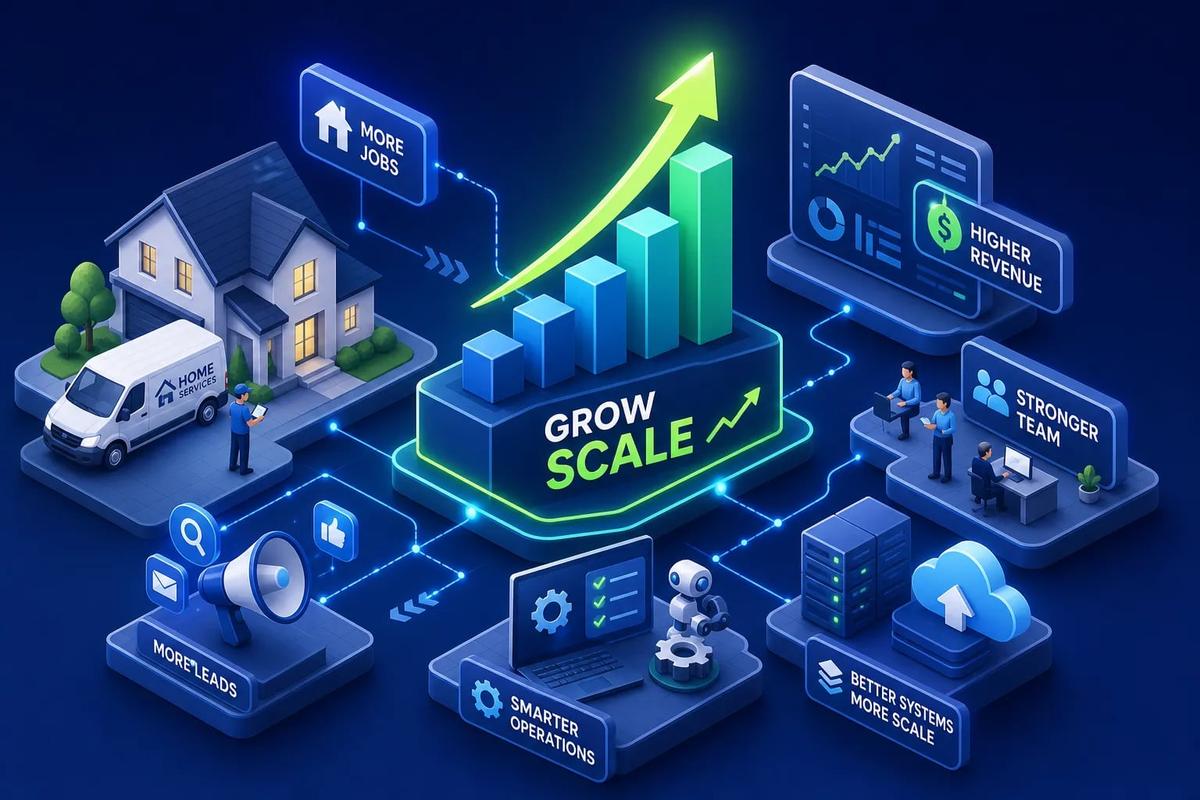
The U.S. home services market sits at $842 billion in 2026 and is growing at 3.27% annually. Home service growth at this scale isn't a niche story; it's one of the largest domestic service markets in the country. And yet, many of the contractors competing inside it are stuck at the same revenue band they've been in for years, not because demand dried up, but because their operations can't absorb what the market is trying to give them.
The businesses scaling fast in 2026 share a common trait: they've stopped treating growth as a marketing problem and started treating it as a systems problem. They're not spending more on ads. They're fixing the machine that ads feed into. Tools like URBLD are helping owners replace the manual bottlenecks that kill conversions, stall dispatches, and delay invoices, so growth creates revenue instead of chaos.
This article covers 12 proven tactics across five domains: marketing, conversion, pricing, operations, and team scaling. Each one is grounded in real market data. Work through them in order or jump to the section most relevant to where you're stuck right now.
1. The 2026 home services market: what the numbers actually say
Why demand is stronger than most contractors realize
The $842 billion figure isn't inflated by one hot segment. It reflects structural demand across roofing, HVAC, plumbing, solar, landscaping, and every other residential and light commercial trade. The CAGR through 2031 holds at 3.27%, meaning this market adds roughly $27 billion in new spending per year. The underlying drivers are durable: U.S. housing stock continues to age, suburban expansion in the Sun Belt and Midwest is driving new construction and immediate service needs, and homeowners who can't afford to move are reinvesting in their existing properties instead.
That last factor matters more than most contractors realize. When the housing transaction market slows, homeowners upgrade in place. Analysts who track long-term housing behavior treat this as a structural shift rather than a rate-cycle side effect, one that keeps demand elevated across trades even when the broader economy gets choppy.
Why home service growth stalls anyway
Here's the paradox: the market is expanding, but many home service businesses plateau. The culprit isn't marketing spend or local saturation. It's operational capacity. When a business can't handle more leads, convert faster, or schedule without friction, growth creates chaos instead of revenue. More calls hit a voicemail nobody checks. More estimates go unsent because someone forgot to export them. More jobs get dispatched late because the scheduler is working off a spreadsheet and three text threads simultaneously.
The market will keep growing with or without you. The question is whether your operations are set up to capture your share of it. The rest of this article is built around that question.
2. The marketing channels that actually fill your pipeline
Local SEO and Google Business Profile: the highest-ROI play most owners underinvest in
Local SEO consistently outperforms most other channels on return for home service growth: reported ROI ranges from 317% to 1,389% depending on trade and market. Google Business Profile is frequently under-optimized in the average home service company's marketing stack. Most owners set it up once and ignore it, a costly mistake. The mechanics that actually move the needle are accurate primary and secondary categories, a steady cadence of new photos, responses to every review (positive and negative), and consistent local citation signals across directories. Think of this as your local contractor lead generation foundation: get it right before scaling paid spend.
The compounding nature of local SEO is its defining advantage. The work you do today keeps paying off for years. Every review, citation, and optimized service page adds to a growing authority signal that paid channels can't replicate. If you're choosing where to invest your first marketing dollar, this is it.
Paid search for fast lead volume
When you need leads quickly, Google Search Ads and Local Services Ads (LSAs) deliver. Well-optimized home service campaigns have posted ROAS in the 7x to 9x range in observed cases. LSAs work particularly well because they appear above standard paid results and carry Google's "Google Guaranteed" badge, which drives call volume for trades where trust matters fast. Standard PPC gives you more control over targeting and messaging; LSAs offer lower friction and a built-in trust signal.
The most common mistake with paid search isn't the bidding strategy or the landing page, it's the follow-up. Letting a hard-won lead sit in a form submission inbox for four hours isn't just wasteful; it's the variable that determines whether paid search is profitable at all. Fast follow-up is non-negotiable.
Building a referral engine that runs on its own
Referrals carry the lowest customer acquisition cost of any channel, often $50 to $150 per acquired customer, and they convert at higher rates because trust is pre-established. The problem is that most businesses treat referrals as luck rather than a system. A deliberate referral engine requires three things: a post-job follow-up sequence timed to the peak satisfaction window (typically 24 to 72 hours after completion), a clear incentive structure that rewards both the referrer and the new customer, and automated review requests that simultaneously feed local SEO and Google Business Profile.
None of this requires a big budget. It requires a consistent process. When referrals are systematized, they compound quietly alongside paid and organic channels.
3. Why your CAC is higher than it should be
Channel benchmarks that reveal where budget leaks
Cost per lead is the most common metric in home service marketing and one of the least useful in isolation. A cheap lead that never books is more expensive than a pricier lead that converts. Here's how customer acquisition cost breaks down by channel: referrals and SEO run $50 to $150; Google LSAs land in the $150 to $400 range; Meta ads average $230 to $500; Google PPC runs $300 to $800 or more; and lead marketplaces like Angi and HomeAdvisor often land at $600 to $1,200 per acquired customer once you account for lead fees, subscription costs, and poor close rates on shared leads.
Lead marketplaces look affordable at the lead level but fall apart at the booked-job level. You're competing with three to five other contractors on the same lead, your close rate drops, and your effective CAC climbs fast. That doesn't mean you should never use them. It means you should track cost per booked job, not just cost per lead, so you know what you're actually paying.
Setting an LTV:CAC target that reflects your trade
The floor for a healthy business is a 3:1 LTV:CAC ratio; the target is 5:1 or better. Trade-specific math makes this concrete: a roofing company paying $400 to $900 to acquire a customer on a $9,000 average job is in solid territory. A solar company spending $800 to $2,500 to close a $25,000 installation is fine. Paying $1,200 in lead marketplace fees to acquire a $500 plumbing job is a structural problem that no amount of marketing optimization can fix.
Calculate your own ratio before you optimize anything else. If your LTV:CAC is below 3:1, the issue isn't which channel you're using, your pricing, retention, or CAC structure is broken at the foundation.
4. Pricing and packaging moves that raise revenue per job
Shifting from hourly to value-based and tiered pricing
Hourly pricing and flat-rate pricing both leave money on the table because they treat every job as equivalent regardless of urgency, complexity, or customer willingness to pay. Value-based pricing reflects the actual worth of the outcome to the customer. McKinsey's research in field service contexts points to meaningful margin gains through dynamic pricing structures, not by overcharging, but by aligning price to the value delivered, which most contractors currently underprice.
Good/better/best packages that lift average ticket size
When customers are given three tiers rather than a single price, a significant share upgrades beyond the base option. The key is structuring tiers around outcomes rather than task lists. A "good" tier solves the immediate problem. A "better" tier solves it more completely and reduces the chance of a callback. A "best" tier includes a maintenance plan, priority scheduling, or an extended warranty. Upsells stop feeling pushy when they're framed as options the customer chooses, not add-ons you're pushing.
Recurring maintenance plans as a revenue floor
Maintenance memberships are among the highest-leverage moves available for home services growth. They convert one-time customers into recurring revenue, which changes the economics of every acquisition you've already paid for. Plans typically price between $99 and $350 per year depending on trade and visit frequency. The structural advantage goes beyond the membership fee: retention improves, LTV climbs, and dependence on constant new acquisition drops. Only 12 to 25% of home service businesses currently sell active maintenance programs, that gap is an opportunity.
5. The operational bottlenecks quietly killing your growth
How fragmented tool stacks create invisible revenue leaks
Most growing home service businesses run on a patchwork stack: a CRM for leads, a scheduling app for dispatch, QuickBooks for invoicing, DocuSign for contracts, and spreadsheets to hold everything together. The handoffs between these tools are where revenue disappears. A lead comes in through the website and sits in a form submission until someone manually moves it to the CRM. A job gets completed but the invoice isn't sent until the admin processes it two days later. An estimate gets generated but never sent because the export step got skipped.
None of these failures are catastrophic in isolation. Together, they represent a consistent, compounding revenue leak that limits how much home service growth your business can actually absorb.
Speed-to-lead and the conversion cliff
Research on home service conversion is consistent on one point: response time is one of the strongest predictors of whether a lead becomes a booked job. Leads contacted within five minutes convert at rates up to 21 times higher than leads contacted after 30 minutes. In home services specifically, booking conversion rates drop from 34% at two to five minutes to 8% at one to four hours and 4% at four or more hours, a 4x to 8.5x difference based entirely on how fast you respond.
When follow-up depends on manual action, speed suffers. Industry estimates suggest roughly half of inbound home service leads never receive a qualifying contact within 24 hours. That's not a marketing problem. That's a process problem, and no amount of ad spend fixes it.
Why hiring more people doesn't solve it
The instinctive response to capacity constraints is to hire another admin or dispatcher. But if the process is broken, adding headcount adds payroll to the same bottleneck. A new admin working inside a fragmented tool stack will hit the same ceiling as the previous one. The real fix is systemic: replacing manual handoffs with automated execution so the process runs faster and more consistently regardless of headcount. That's what separates businesses that scale from businesses that just get more expensive to run.
6. How an AI operating system drives home service growth without adding overhead
What an AI-powered platform actually does differently
URBLD is built as an AI operating system for field service and installation businesses. The distinction from traditional FSM tools is functional. Traditional platforms track work; URBLD is designed to execute it. Lead intake, qualification, scheduling, job execution, invoicing, and accounting sync happen inside one connected platform, no re-entry, no sync delays, no manual handoffs. The AI layer acts the moment conditions are met rather than waiting for a human to trigger the next step.
This matters because most of the conversion and operational problems covered in this article trace back to the same root cause: systems that require human action between every step. When those handoffs are automated, the gaps close and the revenue leaking through them stays in the business.
The revenue cycle the platform runs on autopilot
URBLD's capabilities map directly to the bottlenecks described above. AI-powered lead qualification engages inbound leads immediately, so the speed-to-lead window never expires waiting on a human to check an inbox. Photo-based estimating generates structured, ready-to-send proposals in minutes rather than hours. One-click appointment-to-job conversion eliminates the re-entry step between CRM and dispatch. Automated invoicing triggers on job completion within owner-configured rules, so cash flow no longer depends on someone remembering to send a bill.
Across the revenue cycle, the platform removes the friction points where leads go cold, jobs go unbilled, and growth creates overhead instead of margin.
Why this changes the economics of scaling
When the operational layer runs automatically, growth stops requiring proportional overhead. A business running on this infrastructure can absorb more leads, dispatch more crews, and close more jobs without a corresponding increase in admin staff or coordination effort. That changes the unit economics of scaling fundamentally. Instead of hiring three people to handle the volume that comes with doubling your marketing spend, you invest in infrastructure that handles it without additional headcount. Operational infrastructure isn't a cost center, it's a growth investment with a measurable return.
7. Scaling your team without scaling the chaos
Hiring strategy that supports growth instead of creating drag
The sequencing mistake most home service owners make is hiring before their systems are solid. New employees inherit a broken process, add salary without adding capacity, and the owner ends up managing more people through the same chaos. The right order: fix the operational layer first, then hire into a defined role with a clear process behind it. In terms of which hires unlock the most revenue, the sequence typically runs second crew lead first, then a salesperson focused on estimate conversion, then an ops coordinator once dispatch complexity warrants it.
Technician training as a revenue lever
Standardized service delivery and technician training can reduce service time by 10 to 15%, which directly increases how many jobs a crew can complete per day. Beyond efficiency, upsell training has a compounding effect on average job value. Technicians who understand how to present good/better/best options in the field close more upgrades without the customer feeling pressured. Aligning compensation to job metrics rather than just hours worked changes behavior on the job: techs who earn more when the job closes at a higher value are motivated to learn the conversation that makes it happen.
Managing multiple crews without losing visibility
As you add crews, scheduling complexity grows faster than headcount. One crew is manageable manually. Three crews with overlapping territories, different skill sets, and variable job durations require a system. The mechanics that matter are load balancing across crews, GPS-based clock-in and clock-out for accurate time tracking, automated timesheet compilation, and territory assignment logic that minimizes drive time. Without this infrastructure, utilization drops, idle time climbs, and the cost of running multiple crews erodes the revenue gain. URBLD's workforce module is built to handle this natively, so crew management scales without requiring a dedicated dispatcher for every additional team.
8. The KPIs that tell you if your home service growth strategy is actually working
The metrics that actually predict revenue health
Many businesses default to cost per lead as their primary marketing metric, but it's one of the least predictive numbers in isolation. The figures that actually signal revenue health are: cost per booked job (not cost per lead), estimate-to-close rate by channel and by technician, average job value, and technician utilization rate. Estimate-to-close benchmarks vary by trade: HVAC replacement estimates close at 30 to 45% on average; plumbing and roofing run 40 to 60%; solar closes in the 20 to 40% range. If your numbers fall below these benchmarks, the problem is usually response time, follow-up consistency, or estimate quality, not the lead source itself.
Revenue per technician per day gives you a direct read on operational efficiency. For HVAC, the benchmark is $1,000 to $1,400 per day; plumbing runs similarly at $1,000 to $1,420. If you're significantly below these numbers, diagnose that gap before hiring another technician.
LTV:CAC and the compounding math of growth in home services
The LTV:CAC framework gets more powerful when you model the compounding effects of improving both sides simultaneously. A business with a 2:1 ratio is essentially treading water: acquisition costs consume too much margin, leaving little to reinvest in growth. A business at 5:1 can pour fuel on paid channels, aggressive hiring, and market expansion because the economics support it. The fastest path to improving this ratio combines adding recurring maintenance revenue (which boosts LTV without new acquisition costs) with shifting acquisition toward SEO and referrals (which reduces CAC over time).
When to handle growth in-house vs. bring in a specialist
In-house execution works when the owner or ops lead has bandwidth, the playbook is defined, and the team has the skills to run experiments and measure results. Bring in a specialist when growth has been flat for two or more consecutive quarters, CAC is climbing without a clear explanation, or the team is too consumed by day-to-day firefighting to run any kind of growth initiative. A fractional CMO, a specialized home service marketing agency, or an ops consultant each address a different constraint. The honest question is: do we have the capacity and the knowledge to fix this ourselves, or do we need someone who's already solved this problem?
The bottom line on home service growth in 2026
Home service growth in 2026 is not primarily a marketing problem. For most businesses, it's an operations and systems problem wearing a marketing costume. The 12 tactics covered here, across lead generation, conversion, pricing, team scaling, and KPI tracking, all perform better when the operational layer underneath them is solid. Marketing spend accelerates growth only when the machine receiving those leads can actually process them.
The businesses compounding year over year in this market follow a consistent pattern: they fixed the process first, then poured fuel on it with smarter marketing and a trained, incentivized team. URBLD is the infrastructure layer that makes that sequence possible, removing the manual bottlenecks across the entire revenue cycle so growth becomes a function of strategy rather than survival.
Take the 12 tactics in this article and audit your current operation against each one. Identify the single change that would unlock the most revenue in the next 90 days, and start there. To see how URBLD fits into that picture, request a walkthrough and we'll map the platform against your current stack.
Related articles
Estimate forms for contractors: build one right
Estimate forms for contractors don't have to be a time sink. Learn the right fields, pricing math, and formats, and see how URBLD builds them from photos.
Best Lead Management Software for Field Service in 2026
Compare the best lead management software for field service businesses. See which features, pricing tiers, and platforms keep every lead on track to a booked job.
Best Software for HVAC Contractors: A 2026 Buyer's Guide
Find the best software for HVAC businesses in 2026. Compare top platforms by features, size fit, and pricing, then use our 5-step checklist to choose fast.
Best Facebook Lead Capture Software for Service Businesses
Compare the best Facebook lead capture software for home service businesses. See which tools connect Meta lead ads to your CRM, scheduling, and follow-up automatically.
How Many AC Tons Per Square Foot Does Your Home Need?
Find out how many AC tons per square foot your home needs with a simple sizing chart, climate and insulation adjustments, and tips on when to get a Manual J calc.
ServiceTitan vs Jobber vs All-in-One: Which Wins?
ServiceTitan vs Jobber vs all-in-one platforms compared on pricing, features, integrations, and scalability. Find out which field service software fits your business.
Explore the URBLD platform
Found this useful? Share it with another contractor or service business owner.