Customer Management Software for Service Businesses
One customer record connecting every call, job, document, invoice, and payment — automatically. The 360° customer history other CRMs only pretend to give you.
No credit card required · 14-day trial
One customer record connecting every call, job, document, invoice, and payment — automatically. The 360° customer history other CRMs only pretend to give you.
- Roofing companies
- HVAC companies
- Plumbing companies
- Electricians
- Landscapers
- General contractors
- How the feature works
- Who it's built for
- How it connects to the rest of URBLD
- FAQs and related pages
- One connected record across CRM, jobs, and billing
- AI receptionist and follow-up built in
- Field, office, and AI on the same thread
- Trade-specific workflows, not a generic CRM
- E-signature, PDF, and payments included
- Replaces 6+ disconnected tools
Built for service businesses
Customer management software designed for businesses that do the work — not just sell it.
Roofing, HVAC, plumbing, electrical, remodeling, landscaping, pest control, cleaning — every job creates customer data. URBLD captures all of it on one record, automatically.
One customer, one record
No duplicates. No fragments. No 'which file has the latest info?'
Captured automatically
Every call, job, photo, and payment logged as it happens.
Segmentable & searchable
Find any customer by anything in one second — and group them by any rule.
Owned by the business
Customer data lives in the system, not in someone's inbox.
Need the operational layer for jobs and invoicing? See Customer & Job Management →
Complete customer profiles
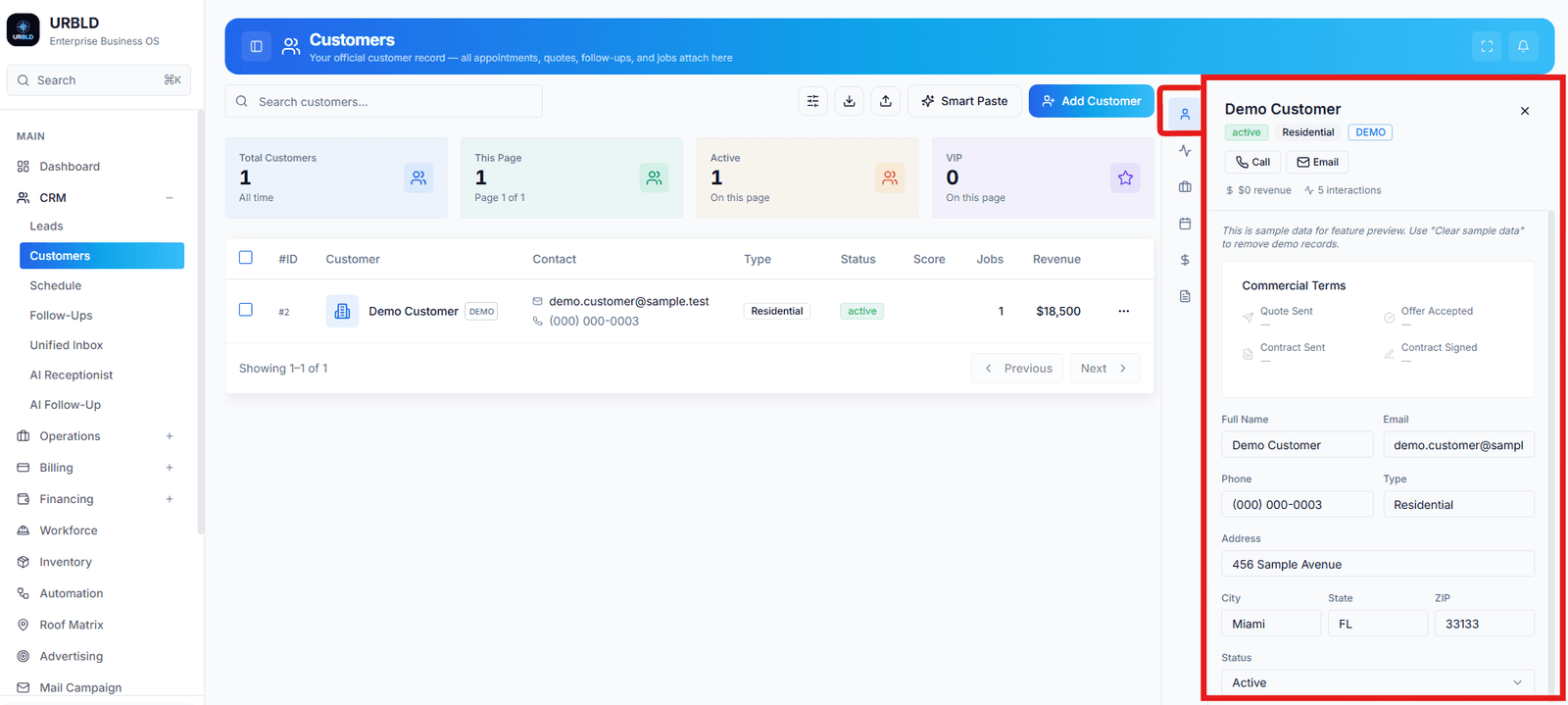
Every customer gets a 360° profile — contact info, property details, lifetime value, payment history, and every job they've ever had with you. One source of truth, not five.
Core Doctrine
This Layer Begins After the Lead Becomes a Customer
Customer Management starts the moment the lead converts. Everything before that — intake, qualification, follow-up, and booking — runs in the lead layer. URBLD owns both layers, so the handoff is seamless.
The full operational lifecycle
Lead Operations
Before the customer exists
Customer Operations
After the lead converts
One record. Every detail.
Open a customer and see the entire relationship — instantly.
Stop digging through inboxes, spreadsheets, and shared drives to figure out who a customer is.
Every call & SMS
Inbound and outbound, automatically attached to the customer.
Every estimate
Approved, declined, or pending — full version history.
Every job
From dispatch to completion, including crew notes and photos.
Every invoice & payment
AR aging, deposits, refunds, and payment methods.
Every document
Contracts, signatures, reports, and field photos.
Every property & location
Multiple service addresses per customer.
A customer record vs. a customer system
Most CRMs give you a contact card. URBLD gives you the entire relationship.
Most CRMs
- Stores a contact and a few notes
- You log calls and emails manually
- Files live in Dropbox or someone's email
- Job history lives in a separate spreadsheet
- Marketing data lives in a separate tool
URBLD
- Connects every job, document, and conversation automatically
- Calls, SMS, and emails are logged the moment they happen
- Every file lives on the customer record — permanently
- Job history, payments, and warranty are part of the customer
- Segments and follow-ups run inside the same system
The full customer lifecycle — in one system
Follow every customer from first lead to lifetime value — without re-entering data between systems.
Lead context carries over
Notes, calls, and qualification data from the lead become part of the customer record — automatically.
See lead qualification →Jobs stay tied to the customer
Every job dispatched, every crew assigned, every photo uploaded — all linked back to the customer permanently.
See scheduling & dispatch →Lifetime value compounds
Repeat work, referrals, and recurring services build the customer's LTV — visible at a glance, not hidden in reports.
See billing & invoicing →No re-entry. No disconnected systems. No lost history.
Customer management for service businesses
Built for the trades and service industries that live or die by repeat customers.
Why customer data breaks
Most service businesses don't lose customers. They lose track of them.
Customer info scattered across email, spreadsheets, and a CRM nobody updates
Photos and contracts trapped on someone's phone or in a shared drive
Job history that lives only in the head of the tech who did the work
No idea which customers are worth $100 vs. $50,000 over their lifetime
Repeat customers treated like strangers because nobody remembers the last job
When a team member leaves, the relationship leaves with them
Every handoff is where information dies.
URBLD makes the customer the permanent record — not a person, not a tool, not a tab.
Customer timelines that stay current — by voice.
Sales reps and field crews can add customer notes and call summaries by typing or speaking. Voice-to-text customer notes keep the office, sales team, and field crew on the same record of what was said and what happened — without anyone stopping to type.
The enemy isn't another receptionist tool. It's disconnected intake.
Most operations don't lose deals to competitors. They lose them to fragmentation — calls, scheduling, dispatch, and follow-up running in unconnected systems with no shared lifecycle state.
Missed handoffs
Calls land in one tool, scheduling in another, CRM in a third. Context dies between systems.
No scheduling governance
AI bots write directly to calendars without dispatch validation — capacity, skill, and territory get violated.
Lost leads
Forms, voicemails, and SMS threads vanish into separate inboxes. No-one owns recovery. Pipeline leaks silently.
Zero operational memory
Each conversation is treated as an isolated event. Lifecycle state, prior intent, and authority history are discarded.
URBLD removes the re-entry layer.
Every call, message, and form arrives into the same operational fabric — linked to the right lifecycle state, governed by scheduler authority, validated by dispatch, and continued in the unified operational thread. There is no fragmentation to recover from because there is no fragmentation.
Real Results
360°
Customer view
100%
History captured
3×
Repeat customer lift
0
Lost files or context
Frequently Asked Questions
Straight answers about how URBLD runs the business end-to-end.