The Hidden Overhead in Service Businesses (It’s Not What You Think)
URBLD Team · May 2, 2026
service business
business overhead
workflow efficiency
field service software
crm
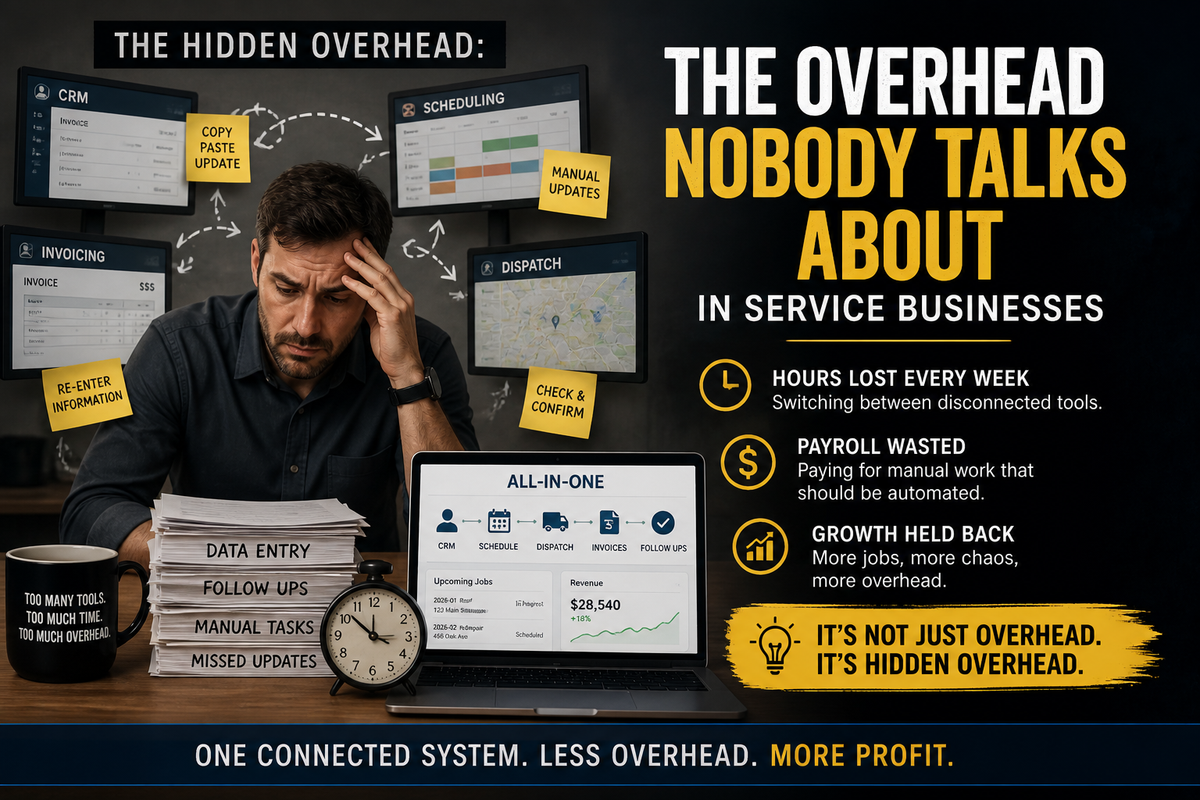
Everyone talks about software costs.
$50 here.
$100 there.
$500/month total to run your business.
And most owners say:
“Yeah, that’s fine.”
But that’s not the real overhead.
The real overhead is the time between your tools.
Switching from your CRM → to invoicing
From invoicing → to scheduling
From scheduling → to dispatch
From dispatch → to follow-ups
“It’s just a few clicks.”
Until it’s not.
10 minutes here.
15 minutes there.
30 minutes later.
By the end of the day?
You’ve lost an hour.
By the end of the week?
That’s 5–7 hours gone.
A full day of work.
Not because your business is broken—
but because your system is.
---
## The Overhead Nobody Sees
Most service business owners think they understand their overhead.
They track software.
They track payroll.
They track expenses.
But they miss the one thing that quietly drains everything:
**The gap between tools.**
It’s not the tools themselves.
It’s what happens in between them.
---
## The Cost of Switching Between Tools
Every day, your team moves between systems:
• CRM to capture leads
• Scheduling to manage jobs
• Dispatch to coordinate crews
• Invoicing to get paid
• Follow-ups to close deals
Each tool works.
But they don’t work together.
So your team becomes the connection.
Copy. Paste. Re-enter. Double-check.
At first, it feels small.
But it stacks fast:
• 10 minutes entering data twice
• 15 minutes confirming appointments
• 30 minutes coordinating updates
That’s easily **1 hour per day gone**.
---
## Why This Costs More Than Software
Most businesses are comfortable paying for tools:
$50/month for CRM
$100/month for scheduling
$200/month for invoicing
Total: $300–$500/month.
That feels manageable.
But what about the time?
What about paying your team to:
• re-enter information
• switch between systems
• manually coordinate work
That’s not efficiency.
That’s **hidden payroll overhead**.
---
## Why Your Business Starts to Feel Chaotic
As you grow, this gets worse.
More jobs = more switching
More customers = more coordination
More revenue = more complexity
And suddenly:
• jobs fall through the cracks
• follow-ups get missed
• scheduling gets messy
• communication breaks down
It’s not your team.
It’s the system holding them back.
---
## The Real Problem
Most service businesses aren’t running on a system.
They’re running on a stack of tools.
Each tool does its job.
But the business doesn’t.
And that gap creates:
• delays
• missed revenue
• wasted time
• higher overhead
---
## The Longer You Wait, The Worse It Gets
At the beginning, you can manage it.
But over time:
• processes get more complicated
• workarounds become normal
• switching costs increase
Eventually, you’re not running your business.
You’re managing your tools.
---
## What Actually Fixes This
The solution isn’t adding another tool.
It’s removing the gap between them.
You need a system where:
• leads flow into scheduling
• scheduling connects to dispatch
• jobs connect to invoicing
• everything updates in one place
No switching.
No re-entering.
No wasted time.
---
## Final Thought
The biggest cost in your business isn’t always visible.
It’s not what you pay for software.
It’s the time you lose because those tools don’t work together.
And once you see it—
you can’t unsee it.
---
See how URBLD connects your entire operation into one system:
Compare URBLD to your current platform
If this essay reflects where your operation is right now, the side-by-side comparison pages are the next read:
- ServiceTitan alternatives — How URBLD compares to ServiceTitan on the lead-to-payment thread — for operators reading this essay and weighing a switch.
Found this useful? Share it with another contractor or service business owner.