Quote Follow-Up Cadence That Books More Service Jobs
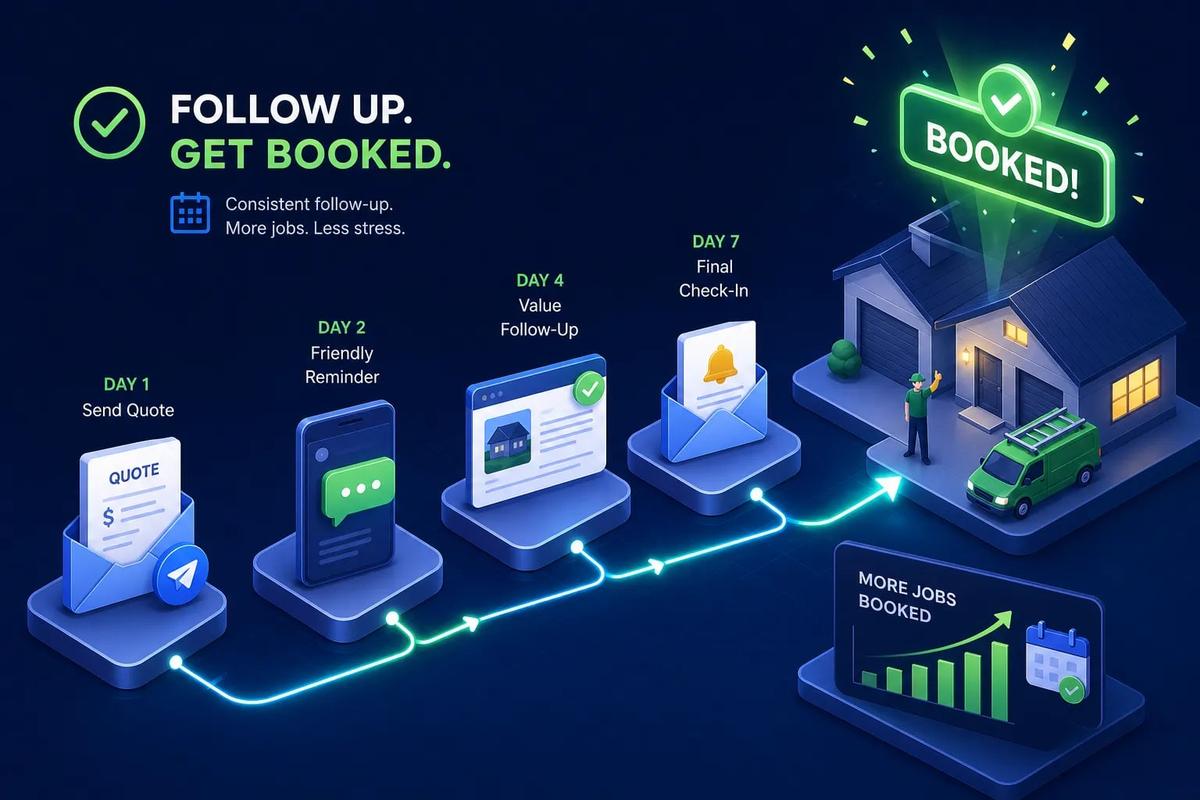
You send a quote, feel good about the conversation, and then the phone goes quiet. Days pass. You do a quote follow up once, maybe twice, and then tell yourself they probably went with someone else. The job gets written off, the lead disappears from your mental list, and you move on. What you probably don't know is that the prospect is still sitting on your estimate, comparing notes, waiting on a spouse's opinion, or just buried under their own week. They haven't said no. They just haven't said yes yet.
The gap between "quote sent" and "job booked" is where most field service revenue quietly disappears. Consider a contractor sending 30 quotes per month at an average job value of $2,500 who converts 40% without any follow-up system. If a structured cadence lifts that close rate to 58%, an illustrative jump, but one consistent with what disciplined outreach produces, that's roughly $13,500 in additional monthly revenue from the exact same pipeline. No more marketing spend. No more leads. Just a better system after the estimate goes out. Contractors running automated follow-up sequences rarely let a warm estimate go cold without knowing exactly why. This article gives you the timing, the templates, the subject lines, and the automation logic to build that same system.
Why quotes go cold before they should
Silence after a quote almost never means no. Homeowners reviewing a roofing estimate typically take five to fourteen days to decide, and that window stretches longer for bigger projects. HVAC and other service decisions can vary widely depending on urgency, project size, and household dynamics. During those days, your quote is competing with everything else in their life: a busy work week, a conversation they haven't had with their partner yet, or three other tabs open in their browser. The contractor who interprets that silence as rejection and stops reaching out is usually the one who loses a job they could have won.
Much of the quote decision activity happens in roughly the Day 3 to Day 14 window after the estimate is sent. That is exactly when the prospect is still actively deciding, weighing their options, and most reachable. Industry observation consistently suggests that only about 10% of non-responses are actual rejections. The other 90% are timing, distraction, or simple inbox burial. The problem is that most field service contractors stop following up in that first week, right when one more thoughtful touch would have made the difference.
The numbers behind this are worth understanding plainly. Commonly cited patterns in contractor follow-up behavior suggest that roughly 48% of tradespeople never follow up on a quote at all. Another significant portion sends one follow-up and stops. Meanwhile, field service sales experience consistently points to five or more touches often being required to close a job. That gap between what contractors do and what actually works is where a structured quote follow up cadence earns its keep.
The 5-step quote follow-up cadence
A reliable cadence doesn't require aggressive sales tactics. It requires showing up at the right moments with the right tone. This sequence is built around how homeowners and commercial decision-makers actually behave after receiving a quote, specifically, the days when they're most reachable and most likely to respond.
Day 2: The receipt check
Send this within 24 to 48 hours of the estimate. This is not a sales push. It's a brief, low-friction message that confirms the quote arrived, offers to clarify any line items, and signals that you're organized and available. Three to four sentences is all it needs. Sending this early matters because the job is still fresh in the prospect's mind, and a quick check-in positions you as attentive without feeling pushy.
Day 7: The soft reminder with value added
By day five to seven, something useful should accompany your follow-up rather than just another "did you see my quote?" A relevant project example, a note about your current availability, or a brief offer to adjust scope or payment terms gives the prospect a reason to reply. The goal here isn't pressure. It's a reason to re-open the conversation on their terms.
Day 14: The direct ask
At the two-week mark, you earn the right to ask a clearer question. Reference scheduling windows or lead times if they apply to your business because field service booking windows create natural urgency without manufacturing it. This is also the right moment to surface potential objections: budget, timing, or a second decision-maker who hasn't weighed in yet.
Day 21: The final nudge
A short, honest message that gives the prospect a clear path forward. Make it easy to say yes, flag a delay, or confirm they're going another direction. Leaving the door open cleanly is better than either disappearing or continuing to chase without purpose. This touch often produces replies that earlier messages didn't, simply because the stakes feel lower when there's no implied pressure.
The breakup with an open door
The psychology behind a well-written close-out message is counterintuitive but reliable: removing pressure lowers resistance. A simple "I'll close this out on my end unless you'd like to revisit it" often prompts a response from prospects who weren't ready to commit but weren't ready to say no either. They weren't ignoring you; they were just waiting for a low-stakes moment to re-engage. This message creates that moment.
Subject lines that get your quote follow up emails opened
The follow-up email that never gets opened doesn't exist, as far as the prospect is concerned. Subject lines are where most follow-up sequences fail silently, and the fix is simpler than most contractors expect. Short, question-based follow up subject lines consistently outperform longer, descriptive ones. The subject line's only job is to earn the open. Nothing else.
Six subject line formulas that work reliably for field service follow-ups:
- The simple question: "Any thoughts on the quote?" Works because it's direct and non-threatening.
- The named callback: "Quick check on your [Project] estimate" Works because specificity signals this isn't a mass email.
- The reply-thread subject: "Re: [Project] quote" Works because it maintains continuity and feels like part of an existing conversation.
- The timeline nudge: "Quote timing for [Project]" Works because it signals relevant scheduling information without overpromising.
- The should-I-close-this pattern: "Should I keep this open?" Works because it's honest and prompts action from hesitant prospects.
- The value-add tease: "A quick idea for your [Project]" Works because it promises something useful before asking for anything.
The patterns to avoid are equally clear. Subjects that repeat the full project description read like task management software, not a person. Generic phrases like "Following up again" signal that this is the fifth message in a mass series. Anything that sounds automated, even if it technically isn't, gets treated like spam. Two to four words or a brief question typically beats a full sentence, though brevity alone isn't enough; personalization and context matter just as much as length.
10 ready-to-use proposal follow up templates
Templates 1, 3: Early-stage follow-ups (Day 2, 5, 7)
Template 1: Receipt check (Day 2)
Subject: Quick check on the [Project] quote
Hi [Name], I wanted to make sure the quote I sent on [date] reached you okay. If it's easier, I'm happy to walk through any line items or adjust scope, timing, or payment terms. Any questions so far?
SMS version: Hi [Name], just checking that the [Project] quote landed in your inbox. Happy to answer any questions.
Template 2: Soft reminder (Day 5, 7)
Subject: Re: [Project] quote
Hi [Name], I'm following up on the quote I sent for [service] on [date]. I know decisions can take a little time, and I'm here if you'd like to review anything together. Would you like me to revise anything before you decide?
SMS version: Hi [Name], following up on the [service] quote. Would you like me to clarify or revise anything?
Template 3: Value-add follow-up (Day 7)
Subject: A quick idea for your [Project]
Hi [Name], one thought on the quote: [brief value point, such as faster turnaround, phased timeline, or an example from a similar project]. If helpful, I can show how we'd handle this in a way that better fits your goals. Are you open to a quick call this week?
SMS version: I had one idea that may improve the [Project] plan. Want me to send it over?
Templates 4, 7: Mid-funnel and objection handling (Day 7, 14)
Template 4: Timeline or availability nudge
Subject: Quote timing for [Project]
Hi [Name], I wanted to check in before the quote validity period closes on [date]. If you're still considering it, I can help with final questions or small scope changes. Would you like to move forward?
Phone script: "I'm calling before the quote expires to see if you need anything adjusted before you decide."
Template 5: Price objection opener
Subject: Options for the [Project] quote
Hi [Name], if budget is the main concern, I can suggest a phased version that covers the most important pieces first. That often helps clients get started without delaying the whole project. Would you like me to outline a lower-cost option?
For roofing or solar contexts, this adapts well to staged payment schedules or permit-phase breakdowns.
Template 6: Social proof follow-up
Subject: Similar [service] projects we've completed
Hi [Name], I wanted to share that we've recently completed similar work for [type of project], with [brief result or outcome]. If useful, I can send a couple of relevant examples or references. Would that help with your decision?
This is especially effective for roofing and exterior work where before-and-after visuals carry real weight.
Template 7: Decision-maker check
Subject: Who else should review the quote?
Hi [Name], I know these decisions sometimes involve one more person. If there's anyone else who should review the quote, I'm happy to answer their questions directly. Should I include anyone else on the thread?
Phone script: "Is there anyone else who needs to weigh in before you can move ahead?"
Templates 8, 10: Final-stage follow-ups (Day 14, 21)
Template 8: Final nudge before closing
Subject: Should I keep this open?
Hi [Name], I haven't heard back on the quote for [Project], so I wanted to check once more. If timing has changed, no problem. I can close it out for now. If you'd like to continue, just reply and I'll help from there.
SMS version: Should I keep the [Project] quote open, or close it out for now?
Template 9: Breakup email with door left open
Subject: Closing the loop on [Project]
Hi [Name], since I haven't heard back, I'll assume the timing isn't quite right. I'll close this out on my side, but if the project comes back around, I'd be glad to revisit it. Thanks again for considering us.
The tone here should feel natural and final, not desperate. This is a respectful close, not a last-ditch pitch.
Template 10: Re-engagement after silence resurfaces
Subject: Reconnecting on your [service] quote
Hi [Name], I'm reaching out again in case your timing has shifted on the [Project] quote. If the need is still there, I can refresh the numbers or update the scope. Would it help to revisit it this week?
Use this when a prospect comes back weeks after going quiet. Keep the tone warm, not "told you so."
Personalization that moves quote follow ups to yes
Personalization in a quotation follow-up email isn't about inserting a first name into a template. It's about referencing something specific from the initial conversation: the exact problem they described, something about their property, their stated timeline, or a concern they raised. A follow-up that connects directly to what the prospect actually said in your first meeting converts at a higher rate than a generic reminder. The prospect feels recognized, not processed.
Three value-adds reliably improve quote acceptance rates in field service contexts. First, relevant project examples: for roofing, solar, and exterior work especially, a before-and-after photo or a brief description of a similar completed job reduces perceived risk more than any sales language. Second, a clear and frictionless acceptance path. If a prospect has to print, sign, scan, and email back a document, you've already lost momentum. E-signature built into the quote itself or a simple "reply to this email to confirm" approach removes the decision friction at exactly the wrong moment. Third, flexible payment or phasing options for larger jobs. Budget hesitation is one of the most common stall points, and offering a phased scope or a payment schedule gives a hesitant prospect a path forward that doesn't feel like a financial leap.
Urgency works when it's real. Scheduling windows, material price holds, and crew availability are genuine leverage points in field service, and referencing them in a follow-up is legitimate. The key is specificity: "We have a crew window opening in the second week of October that would fit your project" reads as helpful context. "Act now or miss out" reads as manufactured pressure. Prospects in this industry know when they're being played, and credibility is harder to rebuild than a deal is to lose.
How many follow-ups are too many
Four to six follow-up touches is the range most field service practitioners and sales researchers point to before moving a prospect to a closed-lost or long-term nurture status. The five-step cadence outlined here lands right in that range. Beyond six touches without any engagement signal, you're usually into diminishing returns, and you risk damaging the relationship you'd want intact if that prospect calls back six months from now with a ready-to-go project.
The signal to escalate is engagement without commitment: the prospect opened multiple emails, clicked through once, or replied with "I'll let you know soon" and then went quiet again. These are warm-but-slow prospects, and they justify more persistence than a contact who has produced zero signal across seven days. For high-value jobs, a brief phone call at the Day 7 or Day 14 mark can unlock deals that a fifth email won't. Some prospects simply respond to a different channel, and a short, conversational call after two unanswered emails often closes more than another message would have.
Know when to stop. Explicit rejection, a contact who has changed roles, or eight touches across 30 days with zero opens or replies, these are signals to close the file. Move the prospect to a long-term drip or a re-engagement list. Don't ghost them, but don't keep chasing without a reason. The breakup-with-an-open-door template exists precisely for this moment.
What automated quote follow-up actually looks like in practice
A roofing or HVAC company sending 40 to 60 quotes per month will often struggle to reliably track who needs a Day 7 follow-up, who opened the email, who replied with a question, and who needs a breakup message at Day 21. Something slips. The contractor mentally chases the deals they remember, not the ones most likely to close. Warm estimates quietly expire while the team is focused on active jobs, and the revenue loss is invisible because no one ever sees the quotes that weren't followed up on.
URBLD is built to handle this from the moment a quote is sent. Triggers fire based on time delays and prospect behavior. No response at Day 2 sends the receipt check. No response at Day 7 fires the soft reminder. A reply with a question routes to the right team member with the full quote and conversation history in view. Because URBLD's CRM, estimating, and follow-up automation all live in the same platform, every automated follow-up references the actual job, the exact quote amount, and the prospect's history. There's no copy-pasting between tools, no syncing between apps, and no dropped context.
Picture two contractors with identical pipelines. The first tracks follow-ups on a whiteboard and relies on memory and email drafts to stay consistent. The second runs an automated sequence that fires a personalized Day 2 check-in, a Day 7 reminder with a relevant project example, a Day 14 direct ask, and a Day 21 close-out message, all triggered from the moment the estimate was sent. Both contractors sent the same quotes. The second one converts more of them with no additional admin time. That is the practical difference between a follow-up habit and a follow-up system.
Turning follow-up discipline into a lasting conversion system
A cadence only improves if you track it. The basic metrics worth watching are: quote-to-job conversion rate by lead source, open rates and reply rates by follow-up stage, and average time from quote sent to job booked. Even simple tracking reveals whether your Day 2 email is doing its job or whether your subject lines need work. You can't adjust what you don't measure, and small improvements in open rate at the Day 7 stage can shift your overall close rate noticeably over the course of a month.
Timing adapts to your market. Residential HVAC jobs often close in three to five days, while a large commercial roofing quote might need a 30-day cadence with touches spaced further apart to match a longer organizational decision cycle. The five-step framework is the skeleton. The timing and tone flex based on your job type, your average customer, and whether you're dealing with a homeowner making a single decision or a facilities manager routing an approval through three people. Knowing your average decision window makes every touch land at the right moment instead of too early or too late.
The contractors who convert the most quotes don't follow up more aggressively. They follow up more consistently. Whether that consistency comes from calendar reminders, a CRM workflow, or a fully automated sequence built into their field service platform, the principle is the same: no quote should go cold without a deliberate reason. Build the system once, let it run, and redirect your attention to doing great work on the jobs that close.
Your quote follow up is the closer
A quiet prospect is not a lost job. A lost job is what happens when you stop following up before you have an actual answer. The five-step cadence, timed at Day 2, 7, 14, and 21 with a clean close-out message, covers the entire decision window where most field service quotes either convert or disappear. Subject lines earn the open. Personalized proposal follow up scripts earn the reply. Consistent timing earns the job.
The businesses converting the most estimates right now aren't necessarily writing better quotes. They're running a better system after the quote is sent. They know which prospects opened emails, which ones asked a question, and which ones need a final nudge this week. That awareness comes from a platform that tracks behavior, automates timing, and keeps every quote follow up connected to the original estimate without any manual effort in between.
If you want this entire sequence to run without anyone on your team having to remember it, URBLD is built for exactly that. The cadence, the templates, the subject lines, and the behavioral triggers all live in the same platform that creates your estimates and manages your jobs. You focus on the work. The system handles the follow-up.
Explore the URBLD platform
Estimate Follow-Up
Glossary
CRM
Feature pages
CRM with Inventory Management
Glossary
How to Stop Missed Follow-Ups From Costing Jobs
Solutions
Follow-Ups
Feature pages
How to Reduce Lead Loss in Service Businesses
Solutions
ServiceTitan Alternatives for Growing Service Businesses
Comparisons
Jobber Alternatives for Service Businesses
Comparisons
Found this useful? Share it with another contractor or service business owner.