Follow-Up Software Built for High-Volume Service Sales Teams
When your company runs dozens of appointments every week across multiple sales reps, follow-up breaks down fast. URBLD keeps every estimate, callback, stale quote, and pending decision organized until the deal is won or lost.
No credit card required · 14-day trial
When your company runs dozens of appointments every week across multiple sales reps, follow-up breaks down fast. URBLD keeps every estimate, callback, stale quote, and pending decision organized until the deal is won or lost.
- Roofing companies
- HVAC companies
- Plumbing companies
- Electricians
- Landscapers
- General contractors
- How the feature works
- Who it's built for
- How it connects to the rest of URBLD
- FAQs and related pages
- One connected record across CRM, jobs, and billing
- AI receptionist and follow-up built in
- Field, office, and AI on the same thread
- Trade-specific workflows, not a generic CRM
- E-signature, PDF, and payments included
- Replaces 6+ disconnected tools
Most service companies invest heavily into generating leads and running appointments — but revenue disappears after the estimate is delivered. Reps move to the next appointment, old quotes go cold, and management loses visibility into what was actually followed up.
URBLD was built specifically for service businesses running high appointment volume across field sales teams. Built for 5+ reps · 20+ appointments/week · thousands of active estimates.
Every rep knows exactly who needs follow-up next
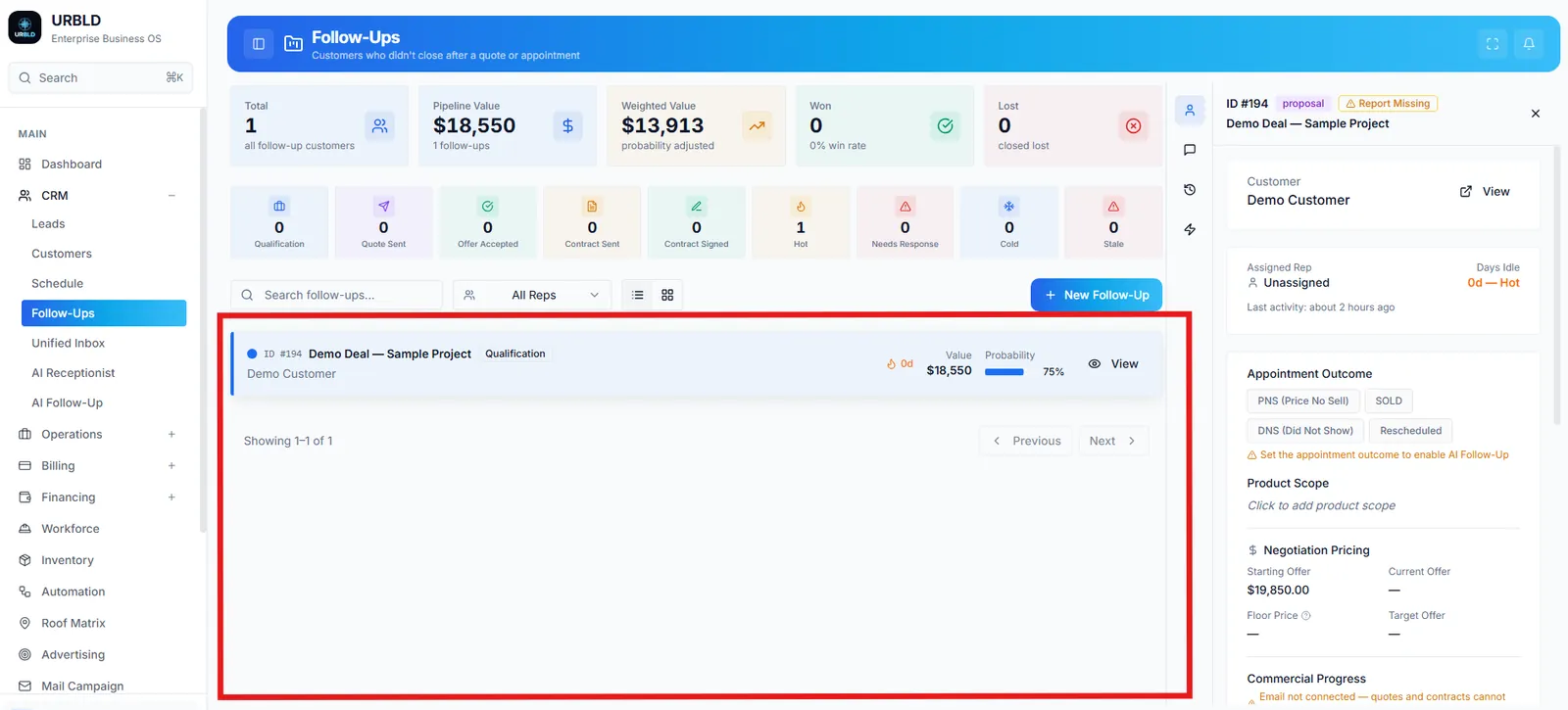
Instead of relying on memory, every stale estimate, unanswered quote, missed callback, pending approval, and inactive customer enters a structured follow-up queue with urgency, reason, and next action clearly visible. Managers see who's following up, who's neglecting opportunities, which estimates are aging, and where pipeline revenue is leaking.
Core Doctrine
URBLD Starts Before the Customer Exists
Most CRMs start when the customer already exists. URBLD starts before that — at lead intake, qualification, follow-up, and conversion.
Most CRMs assume
- — The customer already exists
- — The contact record already exists
- — The sales process already started
- — The appointment is already booked
But businesses break before that
- — During lead intake
- — During qualification
- — During first contact and follow-up
- — During scheduling and dispatch coordination
The full operational lifecycle
Lead Operations
Before the customer exists
Customer Operations
After the lead converts
Lead Follow-Up
Before the appointment.
Goal: reach, qualify, and book.
Quote Follow-Up
After pricing is given.
Goal: recover, negotiate, and close.
The problem isn't generating leads. It's recovering the estimates you already paid for.
In high-volume service businesses, sales reps are constantly moving. New appointments. New inspections. New estimates. New callbacks. The newest lead always feels most important.
Meanwhile, older estimates slowly disappear into spreadsheets, inboxes, sticky notes, personal reminders, and forgotten CRM records. Not because reps are lazy — because the workflow itself is broken.
Most CRMs were never designed for
- 5+ field sales reps
- Dozens of weekly appointments
- Thousands of active estimates
- Multi-stage quote recovery
- Manager approval workflows
- Long sales cycles
URBLD was.
- 5+ field sales reps
- Dozens of weekly appointments
- Thousands of active estimates
- Multi-stage quote recovery
- Manager approval workflows
- Long sales cycles
Prioritized Queue
Every pending follow-up ranked by urgency, reason, and rep.
Recovery & Negotiation
Stale quotes brought back into active negotiation with floor price and approval guardrails.
Approval Control
Discount requests with reason, floor, and audit trail.
Rep Accountability
Visibility into who follows up — and who doesn't.
What Is Sales Follow-Up Software?
Sales follow-up software for service businesses gives field sales teams a structured workflow for everything that happens after an appointment — instead of relying on sticky notes, spreadsheets, or rep memory. With URBLD, teams can:
- Queue every stale estimate and pending callback by urgency
- Track current offer, floor price, and room to negotiate per deal
- Request and approve discounts with full justification
- Recover unsold estimates instead of letting them go cold
- Measure rep follow-up rate and recovered revenue
URBLD connects follow-ups directly into CRM, scheduling, communications, and billing — so reps and managers operate from one system instead of fragments.
Used by roofing, HVAC, plumbing, electrical, construction, and field service companies scaling beyond a handful of sales reps.
Why high-volume sales teams lose revenue after the appointment
The leak isn't in the marketing budget. It's in the operational gap between estimate sent and deal closed — where reps are too busy chasing tomorrow's appointments to recover yesterday's quotes.
80%
Of estimates never get a second serious follow-up
Most field sales teams stop following up after the first attempt — leaving the majority of post-appointment revenue on the table.
Every deal
Stays active until won or lost
Once an estimate is delivered, the deal continues moving through structured recovery and negotiation — instead of fading into private texts and rep memory.
Every action
Logged with user + timestamp
Approvals, offers, follow-ups, customer replies, and status changes are recorded on a centralized timeline so managers know exactly who did what, and when.
The difference isn't more leads. It's owning the recovery process after the estimate is delivered.
See how URBLD connects follow-ups to the rest of your operationFollow-Ups Across the Entire Sales Lifecycle
URBLD follow-ups aren't limited to one stage. The system tracks rep activity and next actions across the full sales pipeline — before, during, and after the appointment.
Before the appointment
- Lead nurturing
- Qualification callbacks
- Appointment confirmations
- Pre-visit reminders
After the appointment
- Recovery & negotiation queue
- Negotiation pricing tracking
- Discount approval requests
- Rep follow-up assignments
After the deal closes
- Won/lost outcome capture
- Reason-coded loss tracking
- Reactivation of cold quotes
- Manager review reports
Why URBLD Is Different from Traditional CRMs
Traditional CRMs store contacts. URBLD owns the post-appointment recovery workflow that traditional CRMs leave to rep memory.
Traditional CRM follow-up
- Stops tracking once the estimate is sent
- No floor price or negotiation room
- No structured discount approval flow
- No visibility into who's following up
- Stale estimates die quietly
- Recovery depends entirely on rep memory
URBLD Follow-Ups
- Continues managing the deal after the estimate
- Tracks current offer, floor price, room to negotiate
- Manager approval flow with written justification
- Per-rep follow-up rate and accountability
- Stale estimates routed back into recovery queue
- Every action logged to the customer timeline
Connected to the rest of your operation
Follow-Ups is one layer inside the URBLD operating system. Every action connects directly into the systems that run the business.
CRM
Lead qualification and customer history.
Scheduling & Dispatch
Appointment reminders and tech coordination.
Unified Inbox
SMS, email, and calls in one thread.
Estimates & Invoicing
Quote recovery and payment reminders.
AI Receptionist
Automated inbound response handling.
Who Uses URBLD Follow-Ups?
Service businesses scaling past a handful of sales reps, where missed follow-up directly impacts revenue, including:
- Roofing companies running multi-rep field sales teams
- HVAC companies managing high estimate volume
- Plumbing businesses with active callback queues
- Electrical contractors coordinating multi-stage proposals
- Construction companies with long sales cycles
- Solar, windows, and exterior remodelers chasing stale estimates
If your company runs 5+ sales reps and dozens of appointments a week, URBLD replaces disconnected follow-up systems with one operational workflow.
Every service company has the same blind spot
Once the appointment is over, follow-up becomes inconsistent. Sales reps focus on tomorrow's appointments instead of yesterday's estimates. Managers assume follow-up happened. Customers wait. Quotes go cold.
Over time, companies lose massive amounts of recoverable revenue — not because leads were bad, but because nobody owned the recovery process after the estimate was delivered.
URBLD was built from firsthand operational experience running thousands of appointments across real service businesses where missed follow-up directly affected revenue growth.
"We stopped losing estimates to silence. URBLD's recovery queue brought back quotes from months ago — and our reps finally know exactly who to call every morning."
The enemy isn't another receptionist tool. It's disconnected intake.
Most operations don't lose deals to competitors. They lose them to fragmentation — calls, scheduling, dispatch, and follow-up running in unconnected systems with no shared lifecycle state.
Missed handoffs
Calls land in one tool, scheduling in another, CRM in a third. Context dies between systems.
No scheduling governance
AI bots write directly to calendars without dispatch validation — capacity, skill, and territory get violated.
Lost leads
Forms, voicemails, and SMS threads vanish into separate inboxes. No-one owns recovery. Pipeline leaks silently.
Zero operational memory
Each conversation is treated as an isolated event. Lifecycle state, prior intent, and authority history are discarded.
URBLD removes the re-entry layer.
Every call, message, and form arrives into the same operational fabric — linked to the right lifecycle state, governed by scheduler authority, validated by dispatch, and continued in the unified operational thread. There is no fragmentation to recover from because there is no fragmentation.
Estimate follow-up guides
How the process works, independent of software — cadence, language, automation limits and trade-specific timing.
Frequently Asked Questions
Straight answers about how URBLD runs the business end-to-end.
Learn more
URBLD Launch vs Starter vs Pro
Pages
Everything Included in Every URBLD Plan
Pages
How to Stop Missed Follow-Ups From Costing Jobs
Solutions
FieldPulse Alternatives for Growing Service Teams
Comparisons
Salesforce Alternatives for Contractors & Service Businesses
Comparisons
MCP for Field Service Software
Knowledge Center
CRM and Field Service Software vs Spreadsheets
Knowledge Center
AI Follow-Up
Feature pages