How to Scale a Service Business Without Losing Quality
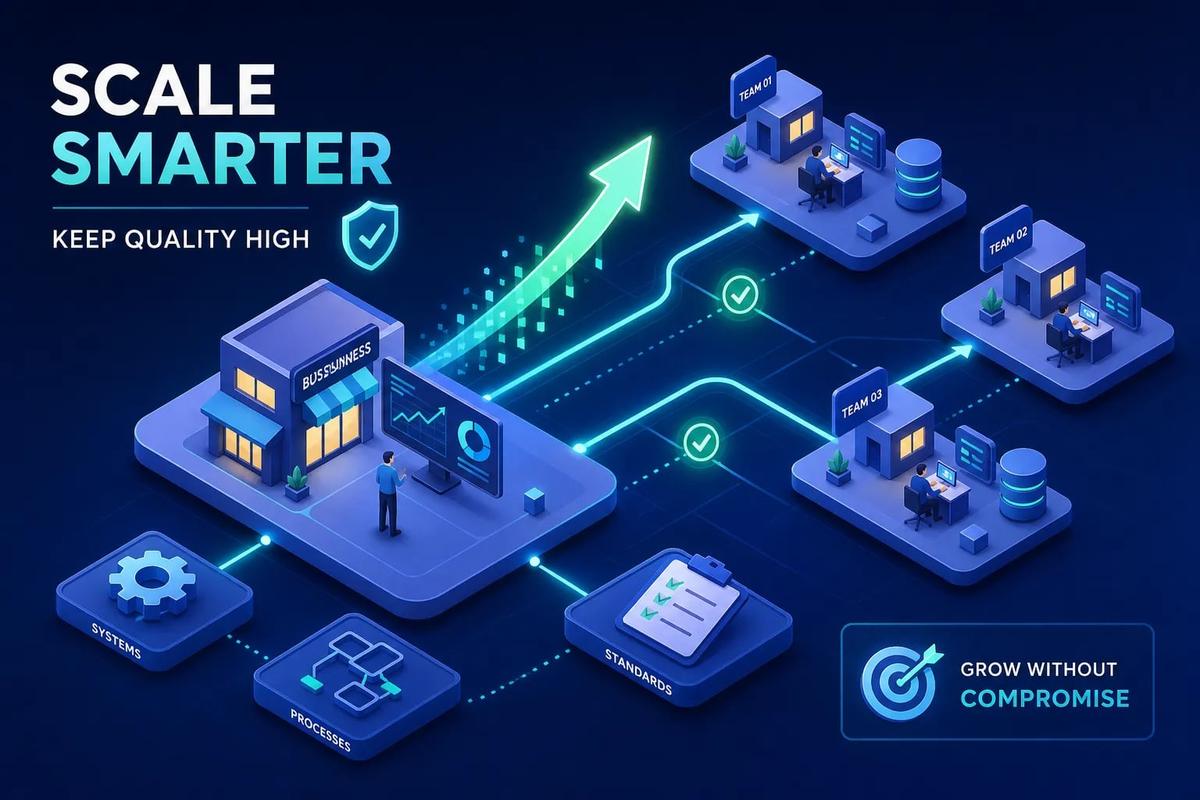
More clients, more revenue, and somehow the business is harder to run than it was two years ago. That's the growth ceiling many service businesses hit, often around $1M in annual revenue for founder-led operations, and it almost never fixes itself without deliberate structural change. The decision to scale a service business surfaces a hard truth: growth starts to feel like a liability when each new job adds pressure instead of profit, the owner is fielding calls at 9 PM, and the team is stretched thin trying to keep up.
The problem is often not demand. Many service businesses that hit this wall have leads coming in. The problem is the operating model underneath the business. When every job depends on the owner's judgment, every invoice requires manual action, and every new hire needs months of unstructured ramp-up time, growth compounds the chaos instead of the revenue.
This guide breaks down the five core levers that actually drive measurable growth: productization, systems, technology, pricing, and people. Field service businesses that have made the shift to AI-powered operating systems show you can grow revenue significantly without growing headcount at the same rate. Here's how to build that kind of operation, starting with why so many service businesses stall before they get there.
Why service businesses plateau before reaching real scale
The scaling ceiling is a structural problem, not a hustle problem. Working more hours or adding more marketing budget will not fix it. The ceiling comes from the architecture of how the business runs, and until that architecture changes, more volume just creates more strain.
The founder bottleneck that quietly caps everything
When the owner is the default decision-maker for scheduling, quoting, quality control, and client escalations, the business can grow only as fast as one person can move. This creates a hard revenue ceiling that more leads will not break through. A packed pipeline is meaningless when every estimate needs the owner's eyes before it goes out, and every problem requires their phone call to resolve.
The ceiling is not about effort. It's about single points of failure. Until decisions can be made without the founder in the room, throughput is permanently capped.
When adding clients breaks the business instead of building it
More clients without better systems creates a compounding problem. Delivery gets slower, errors go up, and client satisfaction drops. Clients who were happy at lower volume start to churn, which means the business is simultaneously adding new customers and losing existing ones. The owner ends up working harder to stay in place rather than move forward.
Why the "just hire someone" instinct fails at this stage
Hiring before documenting and systematizing the work transfers chaos from the owner to the new hire. Without SOPs, training is inconsistent. Without consistent training, quality varies. Without consistent quality, the owner gets pulled back into oversight anyway. Premature hiring without systems does not solve the bottleneck; it just adds payroll to it.
Productize your services before you try to scale them
Scaling a custom-everything service model is nearly impossible. When every job is scoped from scratch, every quote is a one-off negotiation, and every delivery looks slightly different, there is no leverage. Productization is the first real lever because it creates the repeatability that everything else depends on. It's also the foundation of any credible service business growth strategy.
What productized services actually look like
A roofing company with three clearly priced inspection and repair tiers. An HVAC business with seasonal tune-up packages at fixed rates. A solar installer with defined proposal tracks by home size. The specifics vary by industry, but the structure is the same: fixed scope, predictable delivery, and published pricing. Clients know what they are buying. The business knows what it is delivering. Everyone moves faster.
The unit economics behind packaging your work
When delivery is standardized, cost per job drops. Scope creep disappears. Revision loops shrink. Margin becomes predictable because the cost side of each job is no longer a variable. A practical margin floor to target is roughly 2x your fully loaded delivery cost, with 3x, 4x as a healthy growth target. When you hit those numbers consistently across packaged services, throughput per technician increases and the business becomes financially scalable, not just operationally busier.
Moving from custom quotes to repeatable packages
The practical shift starts with identifying your most commonly requested services, a small number of repeatable packages rather than an exhaustive menu. For each one, define the scope boundary clearly: what is included, what is not, and what triggers an upgrade to the next tier. Build the delivery checklist. Set the price. This is not about limiting what you offer; it's about making what you do repeatable so someone other than you can deliver it consistently.
How to scale service business operations with systems and SOPs
Productized services provide the structure. SOPs are what make that structure stick as volume grows. Without documented processes, even the best-packaged service offering breaks down when the person who knows how to deliver it is out sick or leaves the company.
The core SOP stack every service business needs
You do not need fifty SOPs. You need the five to eight that govern the highest-volume, highest-risk parts of the business. For most field service companies, that stack looks like this:
- Client onboarding: intake, kickoff, and first-week milestones
- Job execution: dispatch handoff, on-site procedure, and work standards
- On-site quality control checklist: pass/fail criteria before the crew leaves
- Job closeout: completion confirmation, payment capture, and proof-of-work attachment
- Invoicing and payment: trigger conditions, timing, and accounting sync
- New hire onboarding: role-specific training steps and competency validation
How to document processes so your team actually uses them
SOPs fail when they are written once and filed away. A working SOP has a clear purpose, a step-by-step procedure with screenshots or short videos for tool-specific tasks, quality checkpoints at critical steps, and a named owner responsible for keeping it current. If no one owns it, no one updates it, and it drifts from reality within months.
Training new hires without relying on the founder
The training model that scales uses three stages: shadow first, then perform under observation, then work independently after a validation checkpoint. Each stage has a defined outcome. The trainee is not declared ready until they demonstrate competence on the actual task, not just familiarity with the document. This model lets you onboard consistent quality at higher volume without the founder being in the room for every training session.
The technology layer that lets you scale without scaling headcount
Productized services and SOPs define how work gets done. Technology determines how efficiently that work flows from one stage to the next. The right technology stack does not just track work; it executes the handoffs that your team would otherwise do manually.
What a disconnected tool stack actually costs you
Most service businesses are running four to seven disconnected tools: a CRM, a scheduling app, a separate invoicing system, spreadsheets for job tracking, and maybe a contract tool added as an afterthought. The hidden cost is not just the subscription fees. It's the manual data re-entry between systems, the missed lead handoffs when a new inquiry sits in one platform that nobody checks, the invoicing delays when job completion data lives in the field app but billing happens somewhere else, and the admin hours spent every week just keeping information synchronized. That overhead does not shrink as you grow; it scales right alongside the chaos.
How URBLD replaces the entire revenue cycle in one platform
URBLD is built specifically for this problem. It's not a CRM with add-ons or a scheduling app with a reporting layer tacked on afterward. It's an AI operating system designed for field service and installation businesses, covering the full revenue cycle from the first lead to the final payment in one connected system.
The platform handles lead management with activity-based scoring and automated follow-up, scheduling and crew dispatch with load balancing, photo-based AI estimating that generates ready-to-send estimates without manual data entry, native e-signatures with no third-party tool required, and automated invoicing that triggers on job completion within owner-configured rules. The accounting sync happens in real time, with no manual step required to move data between the field and the books. The AI layer does not wait for a human to trigger the next step: leads get qualified, crews get routed, and invoices go out automatically based on the rules the owner sets once. For roofing contractors, HVAC operators, solar installers, and multi-location service businesses that have outgrown a patchwork of disconnected tools, that kind of operational leverage changes what a small back-office team can actually manage.
The revenue-cycle test: where does your business lose time and money?
Before choosing any technology, run a simple audit. Map the current flow from lead to booked appointment to job execution to invoice to payment. At each handoff, ask: is this step manual? Is data re-entered here? Do leads go quiet here? Does invoicing stall here? The answers identify your highest-leverage technology gaps. Closing those gaps first, rather than chasing feature lists, is what actually expands operational capacity.
Pricing strategies that support scalable margins
Pricing is often the fastest lever available when you scale a service business, and most owners leave significant margin on the table, not because they are undercharging drastically, but because their pricing model does not scale the way their business needs to.
Why value-based pricing outperforms hourly billing at scale
Hourly billing caps revenue at hours available. Once your technicians are fully booked, the only way to grow is to add more technicians. Value-based pricing anchors your price to the outcome delivered, not the time it took. When you can articulate the client benefit clearly and price against that benchmark, a two-hour job that prevents a $15,000 replacement is not priced the same way as a two-hour routine maintenance call. Your margin floor is 2x fully loaded cost, with a healthy growth target of 3x, 4x. Set your packaging structure to reflect those targets, not your competitor's price sheet.
Building a tiered offer structure that drives upgrades
A Good/Better/Best structure accomplishes two things: it gives clients a clear upgrade path, and it gives your business a natural upsell mechanism built into every proposal. The scope difference between tiers should be meaningful and visible to the client. A price jump of 2x, 2.5x between tiers is a commonly observed guideline among service businesses with strong upgrade rates. When the middle tier is priced and described correctly, most clients self-select into it, which is exactly where your margin is strongest.
When and how to raise your rates without losing clients
Annual rate increases applied to new business first are the cleanest approach. For existing clients, 30, 60 days' notice with a clear explanation framed around added value rather than cost inflation is standard practice. Modest annual increases of 3, 8% are low-friction and easy to sustain. Larger increases of 20, 50% are appropriate when your service offering has materially improved. The key is making increases predictable and scheduled rather than reactive and ad hoc.
Hiring structure at each stage of growth
The wrong hire at the wrong stage is expensive in two ways: the payroll cost and the quality risk. The right hire at the right time is a multiplier that removes the bottleneck holding everything else back.
Revenue per employee benchmarks at $1M, $3M, and $10M
For field service businesses, $150K, $200K ARR per employee is a healthy efficiency benchmark, with $100K, $150K acceptable in earlier, delivery-heavy stages. At $1M in revenue, a well-run operation typically has five to ten people. At $3M, fifteen to twenty-five people with clearer functional separation. At $10M, fifty to seventy people with a real management layer in place. Roofing and installation companies often run closer to $200K, $350K per employee due to higher project values. HVAC and plumbing businesses typically land between $150K and $225K per employee as a healthy range. These figures vary by trade and market, so use them as directional benchmarks rather than hard targets.
Which roles to add first and which to delay
The first hire is almost never another salesperson. It's the role that removes the founder from the highest-volume operational task. To identify that role, ask where you personally are the bottleneck most often. If it's scheduling and coordination, the first hire is an operations coordinator. If it's field execution quality, it's a lead technician. Adding sales capacity before removing the operational bottleneck just accelerates the breakdown that already exists.
Separating selling, delivering, and retaining as you grow
By $3M in annual revenue, these three functions need distinct ownership. Mixing them in the same role creates a quality problem: the person responsible for closing new jobs is also responsible for running existing ones and keeping clients happy, which means all three suffer when volume increases. Separating them creates accountability and capacity. It also creates a cleaner hiring profile for each role, which makes the next hire faster and more predictable.
KPIs that tell you scaling is actually working
Revenue growth alone is not the signal you want. A business can grow revenue while shrinking margin, losing clients, and accumulating operational debt that will surface later. These are the numbers that tell you whether scale is creating a stronger business or just a bigger one.
Operational metrics to track weekly
Job completion rate tells you whether work is getting done on schedule or slipping. Average time from lead to booked appointment shows whether your front-end process is converting demand efficiently. Invoice turnaround time post-job reveals whether cash flow is being protected or delayed by administrative lag. When crew utilization is low, revenue per day drops and idle capacity accumulates, tracking that number weekly tells you whether field resources are being deployed productively. Together, these four metrics give you a weekly pulse on operational health without requiring a complex reporting setup.
Financial health indicators to review monthly
Gross margin by service line is more important than total revenue as the business grows, because it shows which services are actually profitable and which are consuming capacity without generating margin. Revenue per employee confirms whether headcount additions are paying off. Collection rate and average days to payment tell you whether revenue is turning into cash or sitting in receivables. Customer acquisition cost measures whether growth is being bought at a sustainable price. If CAC is rising faster than average job value, the growth is unsustainable regardless of what revenue looks like.
Leading indicators that predict future growth
Lagging metrics like revenue and net profit tell you what already happened. Leading metrics tell you what is coming. Lead volume, booking conversion rate, repeat customer rate, and average job value are the four numbers that predict whether next quarter will be stronger or weaker than this one. Operators who track only revenue are always reacting. Operators who track leading indicators can make decisions ahead of the problem rather than behind it.
Your 90-day plan to scale service business operations
Everything above becomes useful only when it is sequenced into an executable plan. The 90-day arc below is not a rigid prescription. It's a prioritization framework designed to avoid the most common mistake: implementing everything at once and finishing none of it.
Days 1, 30: Audit, document, and identify the gaps
Prioritize the audit over implementation in the first month. Map the current revenue cycle from first lead to final payment. At each stage, identify where handoffs break down, where data is re-entered manually, and where the owner is still the required decision-maker. Document the highest-volume processes that need SOPs and start with job execution and invoicing, because those directly affect cash flow and quality. Identify the pricing gap: are current rates below 2x fully loaded cost? If so, the pricing fix is urgent and can begin immediately on new proposals.
Days 31, 60: Implement systems and pricing changes
Deploy the SOP stack for core delivery processes. Introduce tiered pricing for all new clients. Evaluate the current technology stack against a single-platform standard: count the number of tools where data is re-entered, and identify the handoffs where leads, jobs, or invoices get dropped. This is also the window to scope the first strategic hire using the "where am I the bottleneck" test. Begin the hiring process early, because the right hire takes longer to find than most owners expect.
Days 61, 90: Delegate, track, and optimize
Transfer the documented processes to the team. Run the first formal training sessions using the shadow-observe-validate model. Start tracking the weekly and monthly KPIs with a simple dashboard. Review whether pricing changes on new business are holding, and begin the process of notifying existing clients about upcoming rate adjustments. Evaluate whether the technology layer is closing the manual handoff gaps identified in month one. If a disconnected tool stack is still creating data re-entry and missed handoffs, this is the decision point: URBLD exists specifically to consolidate that complexity into one system that executes the revenue cycle rather than just tracking it.
Growth without the chaos is a systems problem, not a hustle problem
Scaling a service business is not a volume problem. More leads without better operations creates faster chaos, not faster growth. The businesses that break through do it by productizing their work and documenting their delivery processes. They price for margin rather than market rate, hire strategically rather than reactively, and build a technology layer that handles operational complexity their team does not have to manage manually.
The 90-day plan in this article is a prioritization tool. Start with whatever is creating the most friction right now, whether that's a chaotic lead pipeline, inconsistent job delivery, or invoicing delays that squeeze cash flow. Fix the highest-friction problem first, then move to the next one. Sustainable growth is built in layers, not all at once.
For service businesses ready to stop duct-taping disconnected tools together, URBLD was built to run the full revenue cycle as one connected AI operating system. Talk to our team about your specific operation and see how the right technology combined with the right model changes what your business can actually scale to.
Found this useful? Share it with another contractor or service business owner.