Best Roofing Business Software for Contractors in 2026
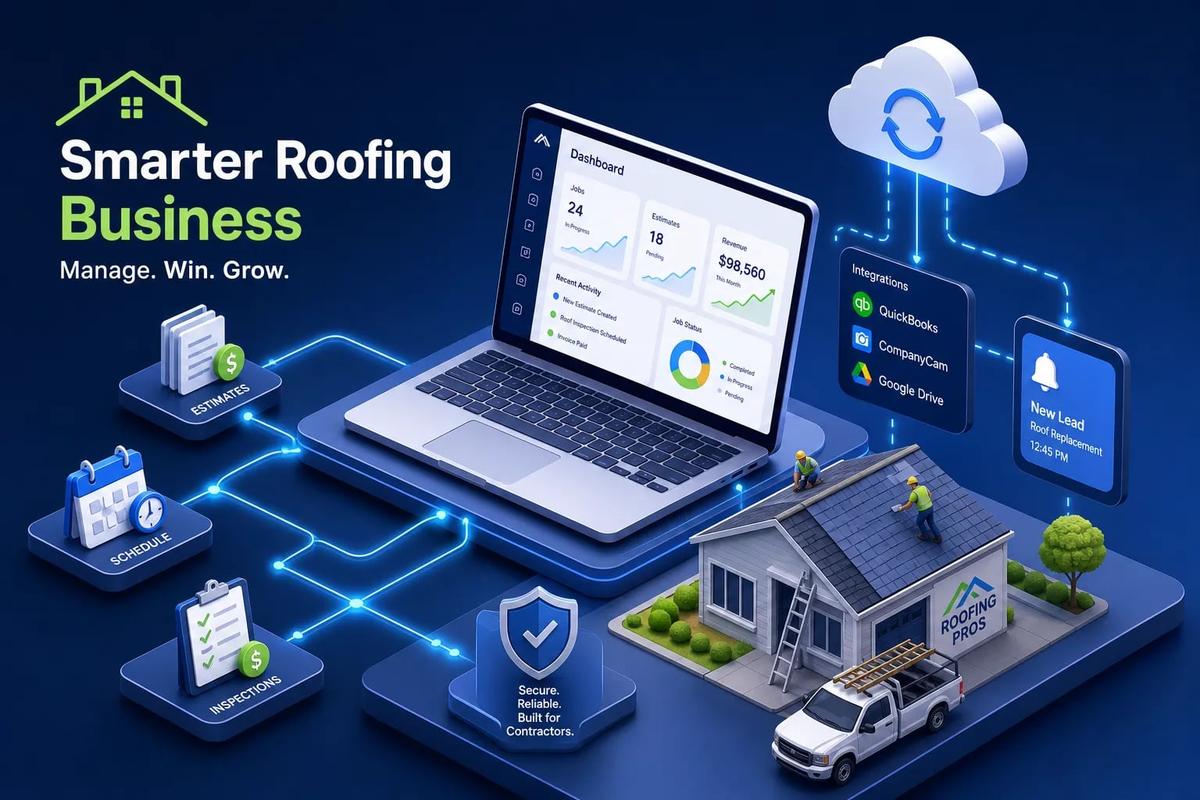
Most roofing contractors are running their business across three to five separate tools and still dropping leads, losing track of crews, and chasing payments. If that sounds familiar, you don't have a time management problem, you have a systems problem. When your CRM doesn't talk to your estimating tool and your scheduler doesn't trigger your invoicing, someone on your team is manually bridging those gaps every single day. Revenue leaks out at every handoff.
The right roofing business software fixes the whole chain: from the first ad click to the final payment, without requiring someone to copy data between platforms. This guide covers what that software should actually do, how the top platforms stack up, what it costs, and how to match a platform to where your company is right now.
What roofing business software actually needs to handle
Most roofing software solves one or two problems well and leaves the rest to spreadsheets or bolt-on tools. A platform worth paying for should cover the entire workflow natively: lead intake, CRM, estimating, crew scheduling, contracts, job management, invoicing, and accounting sync. When any one of those links is missing, data gets re-entered manually, handoffs get dropped, and money walks out the door at exactly the wrong moment.
Every time your estimating software doesn't talk to your scheduling tool, someone on your team is copying information between systems. That manual step introduces errors and dropped context, and those small failures compound fast. Contractors who run on four or five separate platforms often discover they're paying for redundancy and still losing jobs because nothing syncs in real time.
A true all-in-one platform eliminates the integration layer entirely. URBLD is built around this problem. It positions itself as an AI-powered business operating system where lead scoring, estimating, crew dispatch, e-signatures, and automated invoicing run inside one connected system, meaning contractors can evaluate it as a potential alternative to assembling a multi-tool stack. Most platforms that claim the "all-in-one" label still require QuickBooks, DocuSign, or a separate scheduler to complete the workflow.
Lead capture and CRM: where roofing companies lose revenue first
A roofing CRM isn't just a contact database. It should capture leads from ads, web forms, and phone calls, score them automatically based on activity, and trigger follow-up sequences without anyone on your team having to remember to do it. Fast lead response consistently separates higher-revenue roofing companies from those plateaued below their potential, contractors who touch every lead within the first hour convert at a measurably higher rate than those who follow up the next day.
One case study from Roofers United tracked a roofing company that moved its close rate from 18% to 37% in 90 days after implementing automated lead follow-up, adding roughly $380K in annual revenue without increasing marketing spend. That's a systems result, not a sales training result. Your CRM should handle the repetitive follow-up so your reps focus on showing up to the appointment.
Generic CRMs weren't built for field service pipelines. Roofing-specific platforms understand that a lead moves through stages like estimate sent, inspection booked, contract signed, and crew assigned. That pipeline structure tells your team exactly where every job stands without anyone needing to ask. When you're also managing insurance restoration workflows, supplement tracking, and adjuster communication, a generic contact manager becomes a liability rather than an asset.
Roofing estimating software: the features that drive close rates
Roof measurement software has changed what's possible. Platforms like Roofr and QuoteIQ pull aerial measurements directly into the estimate workflow, cutting the time between site visit and proposal from hours to minutes. One Roofr case study documented an 80% reduction in estimate prep time, bringing a 45-minute process down to under 5 minutes per job. At scale, that's hours of labor reclaimed every week.
Proposal delivery speed
Speed closes jobs. Industry data on residential roofing shows that same-day proposals close at 50 to 65%, while proposals sent 24 hours later drop to 35 to 45%, and proposals sent after 48 hours fall to 20 to 30%. The faster your proposal lands in a homeowner's inbox after the inspection, the higher your close rate. Contractors who send proposals on-site or immediately after the appointment win a disproportionate share of the jobs they bid on.
Pricing and margins
Good roofing estimating software should handle multiple material types, margin controls, line-item flexibility, and version tracking so you can adjust a proposal without starting over.
System connectivity
Your estimating tool should connect directly to your CRM so the proposal is already linked to the contact, the job, and the scheduled appointment, no copying between systems. Contractors still building estimates in spreadsheets and emailing PDFs manually are handing margin advantage to competitors who aren't.
Crew scheduling and dispatch: keeping field operations from breaking down
Scheduling for a roofing company is more complex than blocking calendar time. You're managing crew availability, job duration uncertainty, material delivery windows, permit status, and weather contingencies simultaneously. Field service management for roofers should reflect that complexity, with features like load balancing across crews, drag-and-drop rescheduling, and one-click appointment-to-job conversion when a lead confirms.
Without GPS clock-in and live job status, you're managing crews by phone calls and guesswork. Software that gives you real-time location data, time on job, and crew productivity tracking removes the administrative overhead of check-in calls and makes it easier to catch scheduling conflicts before they become missed appointments. For operations running more than two crews, this visibility is the difference between a manageable dispatch board and a daily fire drill.
Many scheduling tools stop at the job level. They don't trigger anything downstream when a job is marked complete. The scheduling-to-invoicing handoff is where many roofing companies quietly lose cash flow. The best contractor management software closes this gap by automatically initiating the invoice the moment a job is completed, within rules the owner configures. That single automation can dramatically reduce invoice turnaround times, from a multi-day lag to something that happens before the crew leaves the driveway.
How roofing business software improves invoicing and cash flow
Most roofing platforms still route contractors to a third-party tool for contracts. That's another login, another subscription, and another place where documents can go unsigned or get lost. Native contract creation, sending, e-signature collection, and document storage inside the same platform eliminates that friction and keeps the job record complete in one place. That's a manageable inconvenience with a handful of jobs, it becomes a real operational problem when you're running 30 active jobs at once.
Getting paid fast is a cash flow issue, not just an admin preference. Roofing business software that triggers invoices automatically on job completion, syncs to QuickBooks in real time, and records payment without manual entry removes the biggest delay in most roofing companies' billing cycle. Kelly Roofing's case study using an integrated management platform reported a 508% ROI with a 2.4-month payback period, largely tied to billing speed and overhead reduction.
Your software should support card payments, ACH, and flexible payment schedules for staged project billing. The key question is whether the payment record syncs automatically to your accounting platform or requires a manual export. Manual exports introduce reconciliation errors and delay your books by days at a time. Users on review platforms consistently flag unreliable sync as one of the most frustrating limitations of roofing software that claims QuickBooks integration but doesn't deliver on it.
The top roofing platforms compared
The roofing software market breaks into two groups: platforms built specifically for the roofing trade, and general field service management tools that roofers adapt to their workflow. Both categories have real options, and the right choice depends on what your company actually needs.
Roofing-native platforms include AccuLynx, JobNimbus, Roofr, and QuoteIQ. AccuLynx is strongest for insurance restoration contractors, with deep EagleView integration, two-way QuickBooks sync, and supplier workflows built into the platform. It's heavier to implement, typically requiring four to eight weeks of setup, and pricing is custom-quoted rather than published. JobNimbus covers CRM, proposals, scheduling, and payments with a mobile app rated at 4.8 stars and setup times in the two-to-four-week range, running roughly $49 to $99 per user per month. Roofr is built around measurement-to-proposal speed with transparent pricing at $249 to $349 per month base plus per-report fees. QuoteIQ adds native Stripe payments, EagleView and Hover integrations, and QuickBooks sync on higher tiers.
General FSM platforms adapted for roofing include ServiceTitan, Jobber, Housecall Pro, and Buildertrend. ServiceTitan is the enterprise choice for larger roofing operations, with full CRM, dispatch, estimating, and payments, but implementation typically runs three to six months and pricing is custom-quoted, often reaching into the thousands per month for larger teams. Jobber and Housecall Pro are faster to onboard, often under a week, and solid for scheduling and invoicing, but they lack roofing-specific depth in estimating, aerial measurement, and insurance workflows. That's the most common reason contractors move away from Jobber as their teams grow: it handles the basics but doesn't support the production-heavy or storm-restoration workflows that drive the business.
For companies that have outgrown a patchwork stack and want to consolidate, URBLD positions itself as an AI-powered operating system designed to run the full workflow, CRM, estimating, scheduling, contracts, GPS crew tracking, automated invoicing, and accounting sync, inside one platform. It's worth evaluating if your priority is reducing the number of tools your team manages and eliminating manual handoffs between systems.
What roofing software actually costs and what ROI looks like
Before you compare platform prices, calculate what your current stack is costing you. Add up subscriptions for your CRM, estimating tool, scheduler, document signing service, and accounting platform. Contractors running four to six tools often find they're already spending $500 to $1,200 per month, and that estimate doesn't account for the staff time spent moving data between systems. That's the baseline you're comparing against, not zero.
The ROI data from real case studies is striking. AccuLynx documented a customer that grew from $1.5M to $8.5M in annual revenue after full platform adoption. ServiceTitan's Boss Roofing case study showed 86% revenue growth and $500K in reduced overhead. At a more accessible scale, a well-implemented roofing CRM that improves close rates by 20 to 30% on a $2M book of business translates to $300K to $600K in incremental first-year revenue without adding a single marketing dollar. That's what happens when leads stop falling through the cracks and proposals go out the same day.
For most roofing contractors, software ROI shows up within 60 to 90 days if the platform is implemented properly. The fastest wins come from automated follow-up, faster proposal delivery, and automated invoicing. Platforms with heavier onboarding like ServiceTitan take longer to reach that point, while tools like Roofr or Jobber often show impact within the first billing month. Payback timeline should be part of your platform evaluation, not an afterthought.
How to pick the right platform for your roofing company
Solo operators and small crews under five people should prioritize ease of setup and scheduling over deep CRM features. Roofr and Jobber are reasonable starting points at that scale. Companies running 10 to 30 people managing multiple crews, insurance claims, and staged billing need roofing-native platforms with estimating depth, contract management, and real-time scheduling. AccuLynx and JobNimbus are the standard choices at that level. Larger operations with complex multi-location needs or high-volume insurance restoration workflows are the natural market for ServiceTitan, though the implementation investment is significant and the monthly cost reflects it.
Get clear answers on four things before signing a contract:
- Does the platform handle all functions natively, or does it require third-party tools for contracts, payments, or accounting?
- What does onboarding actually look like, and what's the realistic time to live?
- Is pricing per user or flat-rate, and what happens to the bill as your team grows?
- Can you see a demo using your actual workflow, not a generic walkthrough built for a different trade?
The platform that answers those questions clearly and without hedging is usually the one that will actually work for your operation. A vendor that requires multiple sales conversations before sharing pricing is often one that will surface additional implementation costs once you're already committed.
Start with your biggest bottleneck
Roofing business software isn't one thing. It ranges from estimating-only tools to full business operating systems, and the right choice depends entirely on what your company needs to run efficiently. Start with the functions costing you the most right now: lost leads, slow proposals, scheduling chaos, or invoices going out days after job completion. The platform that fixes your biggest bottleneck first is the right one to trial.
As your operation scales, the question shifts from "does this solve my problem" to "does this run my whole business without requiring five other tools to fill the gaps." That's when it's worth looking at a roofing business management platform built from the ground up to handle the full revenue cycle in one place. URBLD offers live demos built around your actual workflow, not a generic contractor walkthrough, so you can see how the full system runs before committing to anything.
The contractors growing fastest aren't the ones with the best crews or the most leads. They're the ones whose systems convert more of what they already have. That's a software problem, and it's one worth solving deliberately.
Found this useful? Share it with another contractor or service business owner.