Field service operations best practices that actually work
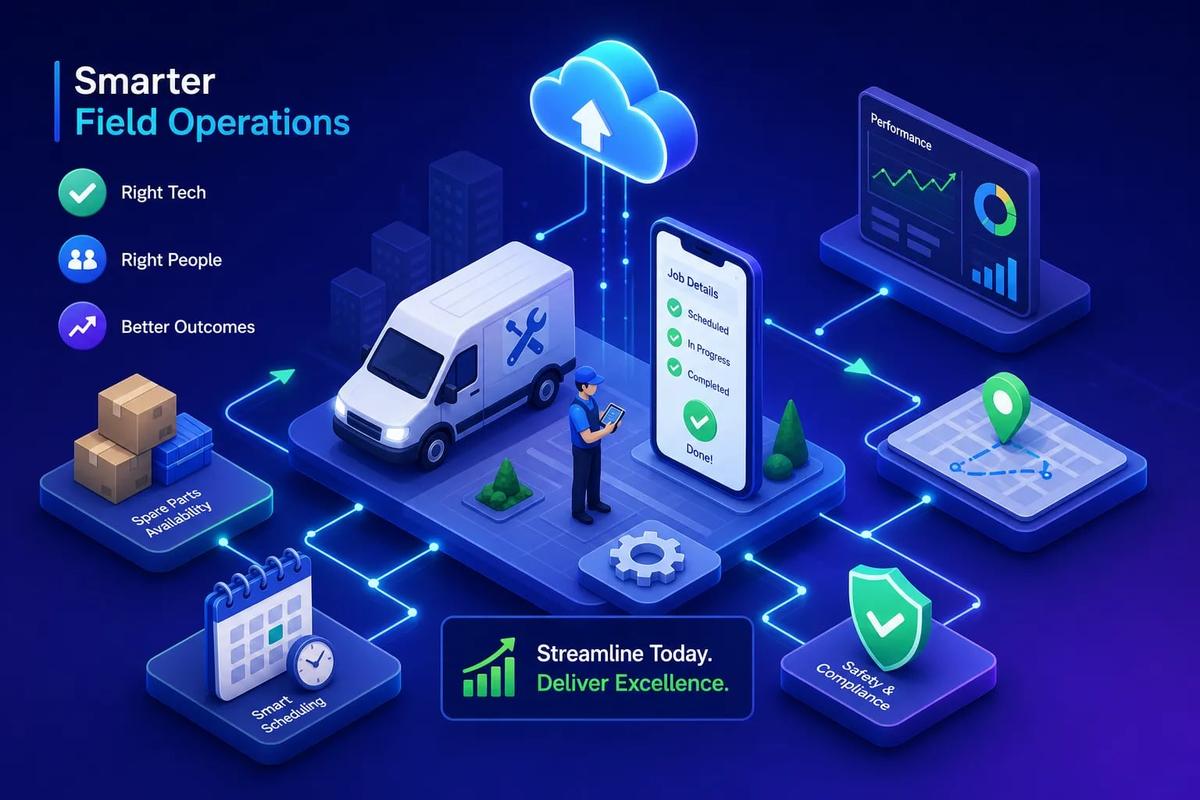
Most field service operations aren't struggling because their teams don't work hard. The crews show up. The phones get answered. The jobs get done. The struggle is almost always structural: five different tools holding five different pieces of the same job, and no clean way to connect them. The lead comes in through one system. The schedule lives in another. The invoice gets created manually days after the job closes. And somewhere in between, information falls through the cracks, customers wait longer than they should, and money that should already be in your account is still outstanding.
The average field service company loses time, trust, and cash flow at every handoff. Not because of careless people, but because disconnected workflows create friction at every transition point. Understanding what's actually broken is the starting point. This article walks through the core operating pillars of a high-performing field service operation: what best-in-class actually looks like, where most businesses fall short, and what a practical path to improvement looks like over the next 90 days.
Why most field service businesses are operating blind
The typical field service operation runs on a patchwork of tools: a scheduling app, a CRM that struggles to gain consistent adoption, a spreadsheet for crew assignments, and an accounting platform that's perpetually running behind. Each tool holds a piece of the picture. No single tool holds the whole thing. Because no one can see the full picture, decisions get made on incomplete information, billing runs late, and customer follow-through is inconsistent at best.
This fragmentation creates a specific kind of operational blindness. Managers can't see which jobs are profitable. Dispatchers can't see real-time crew location. The billing team doesn't know when jobs are actually complete. And customers don't hear anything until something goes wrong. Every one of those gaps represents a cost, in rework, in delayed payment, or in a customer who doesn't call back.
The benchmarks make this concrete. The median first-time fix rate across field service sits around 75, 77%. Top performers consistently hit 86, 90% or higher. Technician utilization hovers between 65, 75% for most businesses, while best-in-class operations push above 85%. Those gaps are not random. They map directly to operational inefficiency. The businesses at the top of the benchmark range aren't running harder. They're running more coherently.
The pattern that keeps most businesses stuck is a reactive loop: a job comes in, someone manually schedules it, a technician gets dispatched with incomplete information, the job takes longer than planned, the invoice goes out days later, and the customer doesn't hear anything until they follow up. That loop is the default mode for most field service operations. Breaking it requires structural change, not simply more effort.
Scheduling and dispatch in field service operations
Manual scheduling sends the available technician, not the right one. That distinction sounds minor until you see what it costs. A mismatched technician takes longer, is more likely to need a return visit, and often doesn't have the right parts. That's a utilization problem, a first-time fix problem, and a customer experience problem wrapped into a single dispatch decision.
Centralized, automated dispatch changes the equation by weighing skill sets, job complexity, crew location, and current capacity at the same time. Research on automated scheduling consistently shows roughly 16% less travel time and meaningfully higher job completion rates compared to manual approaches, though results vary by operation size and routing complexity. That's not a marginal improvement. Across 20 or 30 jobs a day, 16% less travel time is a significant block of productive work hours recovered.
Skills-based routing
Skills-based routing is the most underutilized lever in field service dispatch. Studies on technician-to-job matching indicate that utilization can jump from around 71% to 86.8% with even a one-skill improvement in assignment accuracy. That's a 15-point utilization gain from smarter assignment, not more working hours. In practice, this means routing electrical jobs to licensed electricians, roofing inspections to certified crew leads, and HVAC diagnostics to technicians with the right test equipment. It sounds obvious. Most businesses aren't doing it systematically.
Real-time load balancing
The best dispatch plan still falls apart by mid-morning when a job runs long or a technician calls out sick. Real-time crew load balancing handles this automatically, redistributing workload when conditions change without requiring a dispatcher to manually rebuild the day's schedule. That flexibility separates operations that absorb disruption from operations that unravel under it.
Workforce management for field service operations
When you have more than a few crews running simultaneously, visibility disappears fast. A manager might know generally where each crew is supposed to be, but not where they actually are, how long they've been on a job, or whether they're running ahead of or behind schedule. That information gap makes it hard to intervene early when problems develop.
Crew assignment systems with GPS clock-in and clock-out give operations managers a live picture of where each technician is, what job they're on, and how long they've been there. This is not about micromanagement. It's about having the information you need to make fast decisions. When a technician is three hours into a two-hour job, you need to know that now, not when the next customer calls to ask where their crew is.
Manual timesheets introduce errors that most business owners underestimate. Time rounding, forgotten punch-ins, and disputes over hours create payroll problems and erode trust with field employees. GPS-verified clock-in and clock-out greatly reduces the manual reconciliation burden, making payroll faster to run and easier to verify. The administrative time saved is real. So is the improvement in employee trust that comes from a system that records time accurately and transparently.
For a concrete target: best-in-class billable technician utilization in mobile workforce management runs between 75% and 85%. Below 65% typically signals scheduling gaps, excessive travel, or poor job assignment. Above 85% can mean technicians are being overscheduled without buffer, which tends to drive errors and burnout. Most businesses don't track this number consistently. The ones that do tend to find the gaps quickly.
First-time fix rate is the number that tells the whole story
First-time fix rate is the single metric that exposes the quality of everything upstream. It's not a customer satisfaction score. It's a diagnostic tool that reveals the accuracy of your job information, the readiness of your parts, the precision of your technician matching, and the quality of your dispatch data. When FTFR is low, the problem is almost never technician competence. It's that technicians arrived without what they needed to complete the job.
Industry benchmarks place the median FTFR around 75, 77% across field service. HVAC averages between 68, 82%, with top-quartile operators reaching 88, 92%. Top performers in broader field service contexts hit 86, 90% or better. The gap between a 75% first-time fix rate and a 90% one isn't a small improvement. It's the difference between one in four jobs requiring a callback and fewer than one in ten. Callbacks cost labor, parts, and scheduling capacity, and they erode customer trust in ways that don't always show up until a renewal decision or an online review.
Three factors drive a high first-time fix rate more than anything else: pre-job diagnostic information, correct parts staging, and accurate skill matching. When technicians arrive with detailed job history, customer notes, asset data, and photo-based pre-assessment, the probability of resolving the issue on the first visit rises significantly. One documented 90-day operational transformation raised FTFR from 61% to 94%, cutting callbacks by 68%. The change wasn't a different workforce. It was better information flowing to the field before the job started.
Most businesses treat parts management as a completely separate function from scheduling. That separation is exactly the problem. When inventory awareness isn't connected to the dispatch process, technicians get sent to jobs without the parts they need, and the first visit becomes a diagnostic trip instead of a resolution. Integrating inventory into dispatch, so that the right parts are staged before a technician is assigned to a job, directly raises FTFR without changing anything else about how the work is done.
Invoicing in field service operations: stop the leakage
The typical field service invoicing process has four to six manual steps between job completion and the customer receiving a bill. A technician closes the job on-site. Someone back at the office creates the invoice from notes or photos. Someone else reviews it. It goes out two or three days later. Then the business waits for payment. Each handoff is an opportunity for delay, error, or the invoice to fall through the cracks on a busy week.
Automated invoicing triggered on job completion is not just a convenience. It has measurable cash flow impact. Deployments of mobile field operations management platforms have shown invoice processing speed improve by roughly 50% and operational errors drop significantly when invoicing is triggered automatically at job close. Manual invoicing error rates typically run around 15, 20%. With automation, they can fall below 2%. The errors that get eliminated are under-billing, missing line items, and incorrect rates, all money the business earned and failed to collect.
Payment cycle timing shifts as well. Manual invoicing cycles often run 35, 45 days from job completion to payment. Automated invoicing with built-in follow-up has been associated with payment times dropping to 12, 18 days. For a business running high job volume, that difference in cycle time represents weeks of working capital sitting in someone else's account instead of yours.
Even businesses that invoice relatively quickly often spend hours every week reconciling invoices with their accounting software. When FSM platforms don't sync natively with accounting systems, someone is manually re-entering data across systems. That creates version errors, eats administrative time, and ensures the books are always a few days behind reality. The accounting sync gap is where most businesses quietly lose hours every week without ever naming it as a problem.
Customer communication isn't a soft skill, it's a system
Customer expectations in field service have shifted. People expect appointment confirmations, precise arrival windows, technician details, and post-job summaries. They're used to real-time tracking notifications from package deliveries. A technician showing up unannounced or a customer waiting three days for an invoice with no update is not a minor inconvenience. It's a reason to leave a one-star review and call someone else next time.
Systematic customer communication follows a defined sequence: an automated confirmation when a job is booked, a reminder 24 hours before the appointment, a technician-on-the-way notification with an ETA, a job completion summary, and prompt invoice delivery. None of these should require a human to manually trigger them. When they're automated and consistent, the customer experience improves without adding any administrative load on the team.
The data on this is consistent across case studies: businesses that systematize customer communication see CSAT improvements ranging from 20 to 45 points. Customers don't rate field service based solely on the quality of the work. They rate it heavily on how they felt throughout the process, whether they knew what was happening, whether their time was respected, and whether the follow-up was professional. A business that communicates proactively earns more referrals and more repeat business than one that does equally good work with poor follow-through.
What AI does that disconnected software never could
Reactive field service waits for something to break and then dispatches someone to fix it. Predictive field service uses data, including job history, asset condition, seasonal patterns, and IoT sensor signals, to anticipate failures before they happen. The difference in outcomes is significant: predictive maintenance has been associated with 25, 30% lower maintenance costs and 35, 50% less equipment downtime compared to reactive models. Remote diagnostics can reduce mean time to resolution by a substantial margin by giving technicians a pre-diagnosed problem and the right parts before they arrive on site.
Many FSM platforms use AI primarily as a reporting layer, showing you what happened after the fact. A genuine AI operating system acts inside the workflow: it qualifies leads, routes crews, generates invoices, and drafts purchase orders without waiting for a human to trigger each step. That distinction matters more than most people realize. The question isn't whether your software has AI features. It's whether the AI executes work or just observes it.
URBLD is designed to function as an AI operating system across the full operational cycle, not as an analytics dashboard bolted onto a scheduling tool. The AI layer runs across scheduling, dispatch, invoicing, lead management, and inventory simultaneously, acting on cross-functional signals in real time. That's only possible because all of that data lives in one place. When job data, crew data, inventory data, and accounting data are connected natively, the system can act on the full picture. When they're separate tools, no amount of AI reporting fixes the underlying fragmentation.
A business running five tools with one AI assistant is still running five tools. Platform consolidation isn't about reducing the number of subscriptions you pay for. It's about giving every workflow access to the same data, so that automated actions are informed by what's happening across the entire operation. That coherence is what separates businesses that scale without adding headcount from ones that grow by piling more manual coordination on top of an already fragile stack.
A 90-day action plan for stronger field service operations
Not every improvement has equal leverage. The three moves that tend to deliver the fastest visible results are auditing first-time fix rate and tracing every callback to its root cause, tightening dispatch through skills-based routing, and automating invoicing to close the lag between job completion and payment. These three changes improve cash flow, technician productivity, and customer satisfaction simultaneously, and they don't require rebuilding your entire operation at once.
Start with the FTFR audit in weeks one through four. Pull your callback data and categorize each one by root cause: was it a parts issue, a skill mismatch, or incomplete job information? That categorization tells you exactly where to intervene. Parts problems point to inventory integration with dispatch. Skill mismatches point to skills-based routing. Incomplete information points to better pre-job briefing workflows. The root cause tells you what to build first.
In weeks five through eight, tighten the dispatch model. Implement skills-based assignment if you aren't already doing it systematically. Add real-time crew visibility so dispatchers can intervene early when jobs run long. Connect inventory awareness to the scheduling process so technicians don't get sent to jobs without the parts they need. Each of these is a discrete change with a measurable effect on utilization and first-time fix rate.
In weeks nine through twelve, close the invoicing loop. Automate invoice generation on job completion. Verify that your FSM platform syncs natively with your accounting system so there's no manual re-entry step. Set up automated payment reminders. These changes reduce the billing cycle from days to hours and cut the administrative overhead that's currently consuming time your team could spend on higher-value work.
Track four numbers from day one: first-time fix rate (target above 80%, best-in-class above 86%), billable technician utilization (target 75, 85%), average invoice-to-payment cycle time, and customer satisfaction score. These four metrics, tracked consistently, tell you whether the improvements are working or whether there's still a structural problem to address. If you're not measuring them today, start now. You can't improve what you can't see.
The real competitive advantage is operational coherence
Field service operations don't fail because of effort. The teams are working. The problem is that information and execution are disconnected, which means effort gets spent on coordination, rework, and manual tasks instead of on the work itself. The best field service businesses have solved this by building operations where every job flows through a single system, every handoff is automated, and every key metric is visible in real time.
The playbook isn't complicated. Fix the dispatch model. Get real visibility into your workforce. Automate invoicing. Communicate with customers systematically. Make sure your technology executes work rather than just records it. Those four moves, done consistently, separate the businesses that scale without adding headcount from the ones that grow by adding more people to manage more chaos.
URBLD is built to run field service operations as a single connected system, across scheduling, dispatch, workforce management, invoicing, and customer communication, where every function shares the same data and the AI executes across all of it. Not as a collection of integrated modules, but as one operating system. If you want to see how that works in practice for an operation like yours, reach out to our team and we'll walk you through it.
Explore the URBLD platform
Found this useful? Share it with another contractor or service business owner.